
Part 1: The Night My Son Walked Into a Locked Trauma Room
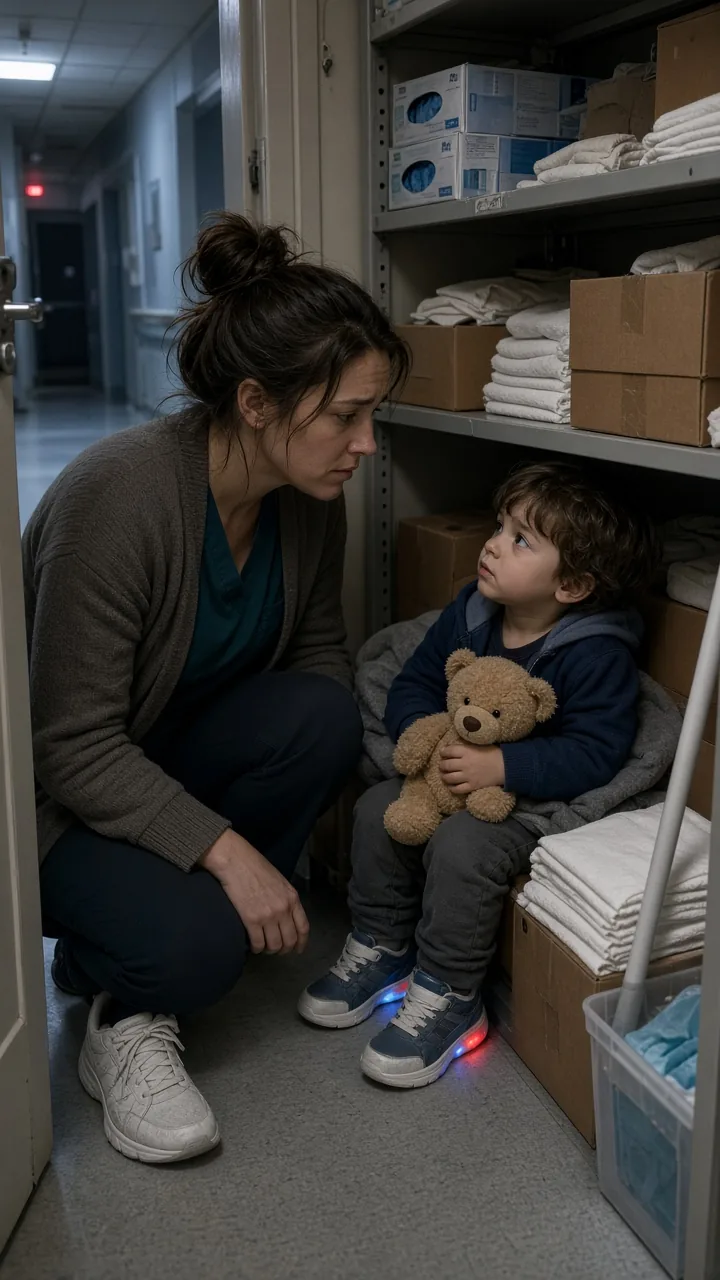
Two years before the night everything changed, I buried my husband while our son was still young enough to sleep through most of the funeral. David Winters had been killed by a drunk driver six weeks after Logan was born. That was what the police report said. That was what the hospital told me. That was what I had repeated so many times that the sentence no longer sounded like language. After that, life became a list of things I could barely keep from falling apart. Rent. Preschool. Formula, then groceries. A car that made a grinding sound every time I turned left. Collection calls I learned to silence before Logan heard them. Whenever he asked why other kids had dads waiting outside preschool, I told him his father had loved him more than anything. I never told him how angry I still was. The night shift at Johns Hopkins was supposed to be simple. My babysitter would stay with Logan until I got home, and I would spend eight hours cleaning rooms, stocking carts, and trying not to think about the overdue electric bill. Then my babysitter called from urgent care. She had suffered a severe asthma attack and could barely finish a sentence. I stared at the clock. My supervisor had warned me three days earlier that one more missed shift would cost me my job. So I made the worst decision I had ever made as a mother. I brought my three-year-old son to work. Near the end of a quiet service corridor, I found a supply closet large enough for him to sit behind boxes of gloves and folded towels. I spread my cardigan on the floor, handed him his stuffed bear, and crouched in front of him. “You stay right here with Captain Bear,” I whispered. Logan looked up at me, solemn and sleepy. His sneakers blinked blue when he moved his feet. “Promise?” “Promise, Mommy.” One floor above us, men in dark coats had taken over the VIP wing. I did not know the patient’s name at first. I only knew that armed security had appeared near the elevators and nurses were speaking in clipped voices. Then someone whispered it. Alessandro Romano. In Baltimore, people knew the name even if they pretended they did not. Romano controlled businesses all over the harbor, and the rumors around him were darker than anything printed in the papers. He had been brought in after an ambush with three gunshot wounds. For hours, surgeons worked behind closed doors while his men filled the hallway. At 2:14 a.m., the alarms inside the trauma suite went quiet. A doctor stepped out. “Time of death.” One of Romano’s men, a huge man with blood dried across his knuckles, dropped to his knees. The others did not move. Their silence frightened me more than shouting would have. My supervisor caught my arm as I pushed my cart toward the service elevator. “Stay away from that floor.” “My son is waiting for me.” Her expression hardened. “Then you should have arranged childcare.” I wanted to scream at her. Instead, I swallowed it. I needed the paycheck more than I needed dignity. I finished the last room on my list and hurried downstairs. The supply closet door was open. My cardigan was still on the floor. Captain Bear was gone. “Logan?” I ran the corridor, checked the break room, the restroom, the empty waiting area. Then I heard his voice through the partially sealed trauma-suite door. “You’re cold,” he whispered. “Captain will help.” I shoved the door open. My son was curled across Alessandro Romano’s chest, his stuffed bear tucked beneath the dead man’s arm. Every man in the room turned toward me. Several hands moved toward concealed weapons. “Logan!” My son lifted his head. Then the heart monitor beeped. Once. Twice. A third time. A nurse froze. Someone shouted for the doctor. Alessandro Romano’s fingers moved and closed weakly around Logan’s wrist. His eyes opened. He did not look at the doctors rushing toward him. He did not look at the armed men surrounding the bed. He looked directly at me. “David Winters,” he rasped. I stopped breathing. “How do you know my husband?” His face tightened with pain. “Because he didn’t die in that car.” Behind me, the lock clicked. For the first time in two years, I realized I might not know what happened to the man I had buried. A mother can forgive a secret told to protect a child. A wife may see the same secret as a betrayal that stole years she can never get back.
Part 2: The Heartwarming Resolution
I turned toward the locked door. “Open it.” No one moved. I pulled Logan against me so quickly that Captain Bear fell to the floor. My son began to cry, confused by the doctors, alarms, and men staring at us. Alessandro Romano lifted two fingers from the bed. “Open the door.” The guard obeyed. A doctor tried to clear the room, but Alessandro caught my sleeve. “Your husband worked for me.” I stared at him. “No. David worked in accounting.” “For one of my companies.” The room seemed to tilt. David had handled financial records for a logistics company connected to Romano’s businesses near the Port of Baltimore. Then he found payments that made no sense: shell vendors, vehicles bought under false names, cash withdrawals before acts of violence Alessandro claimed he had never authorized. David copied the records. Then he went to federal investigators. “So he was informing on you?” “On men inside my organization,” Alessandro said. “Men who were stealing from me and killing people to protect it.” I wanted to reject every word. David had packed Logan’s diaper bag. David had burned pancakes on Sundays. He had driven across Baltimore at midnight because I once said I wanted peach ice cream. But Alessandro knew things he should not have known. He knew David called me Cat only when he was scared. He knew about the cracked watch David inherited from his father. He knew David kept Logan’s hospital bracelet folded inside his wallet. “What happened the night of the crash?” Alessandro closed his eyes. “The crash was meant to kill him.” David survived. The driver who struck him had not been drunk by accident. Federal agents moved David before the people searching for him reached the hospital. The death story had been created because David’s cooperation was part of a larger investigation and because Logan and I were already being watched. I felt sick. “He let me bury an empty coffin?” “He believed grief would keep you alive.” “That was not his choice to make.” “No,” Alessandro said quietly. “It wasn’t.” For the first time, nobody defended David. I asked the only question that mattered. “Is he alive now?” Alessandro looked at Logan. “Yes.” An hour later, two federal agents arrived through a private entrance. They did not tell me everything, but they told me enough. David had spent almost two years in protective custody while prosecutors built cases from the financial records he had copied. Threats against witnesses had slowed everything down. The shooting that put Alessandro in the hospital was tied to the same remaining group. One agent placed a secure phone on the table in a consultation room. “There are rules,” she said. “You can end the call whenever you want.” The screen came on. David looked older. Thinner. Alive. For several seconds, neither of us spoke. Then he saw Logan asleep against my shoulder. David covered his mouth. “Cat.” I had imagined hearing that voice every night for two years. When it finally came, I did not run toward it. “You let me tell our son his father was dead.” His eyes filled. “I know.” “You let me struggle alone.” “I know.” “You don’t get to say you did it for us and make that erase what it did to us.” “I know.” That was the first thing he said that helped. There was no instant forgiveness and no promise that life would return to normal. Over the following weeks, federal authorities moved Logan and me temporarily while arrests were made and the immediate threat faded. David gave his final testimony. Our first reunion happened in a plain government office outside Baltimore. Logan stood behind my leg, studying the stranger he knew only from photographs. David crouched several feet away and did not reach for him. Then Logan held out Captain Bear. “My bear helps people wake up.” David laughed and cried at the same time. I still did not know whether our marriage could survive what had happened. But for two years, my life had been built around a grave that held no husband and a story that had never been true. That day, I finally stopped living inside someone else’s version of my loss and began deciding what came next for my son and me. A tired Baltimore hospital worker crouches beside her three-year-old son in a supply closet, giving him a stuffed bear before returning nervously to her night shift.
Discover more heartwarming stories and emotional moments on our main editorial page.