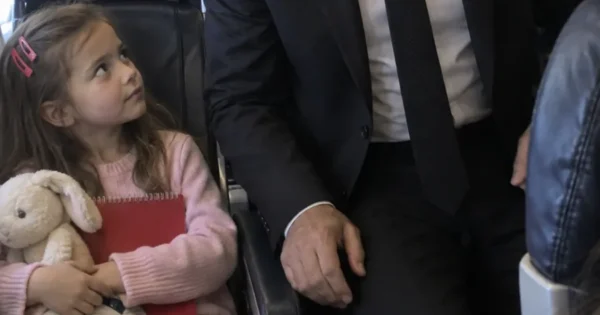

Part 1: The Unexpected Encounter
The Ticket Said Seat 2A, but the Flight Attendant Told Malik to Move “Get out of that seat. Now.”
The order cut through First Class on Canyon Crest Airlines Flight 227 and turned every face toward eleven-year-old Malik Johnson.
Malik sat frozen in Seat 2A, his hands folded over a navy sweater. His pressed slacks, polished shoes, and monogrammed leather backpack made him look exactly like what he was: a careful child on his first flight alone.
Lead flight attendant Catherine Ward stood over him as if he had wandered into the wrong cabin.
“First Class is full,” she said, pointing toward the rear. “Take your things and move.”
Malik looked down at the boarding pass beside him.
Seat 2A.
“This is my seat.”
He held up the ticket. Catherine barely glanced at it.
Around them, passengers shifted without speaking. A man lowered his newspaper. A woman stared at her phone, thumb motionless above the screen. Everyone seemed to understand that something was wrong, but no one wanted to be the first person to say it.
Malik’s stomach tightened.
His father’s instructions from that morning came back to him.
Keep your documents close. Stay calm. Call me if something feels wrong.
He raised the boarding pass again.
“I’m not asking for somebody else’s seat,” Malik said. “This one belongs to me.”
Catherine’s expression hardened.
She bent down, pulled his backpack from beneath the seat, and dropped it into the aisle.
The leather hit the floor with a hard thud.
Malik stared at it.
The humiliation hurt more than the noise. His eyes burned, but he refused to cry in front of a cabin full of strangers.
He knew how assigned seating worked. He had traveled First Class with his father before. The ticket had been purchased weeks earlier, his name matched the reservation, and the gate agent had scanned him onto the flight without a problem.
That should have been enough.
What Catherine did not know was that Malik’s father, David Johnson, founded Johnson Aerotech, a major aviation systems company with a long corporate contract with Canyon Crest Airlines.
Malik could have said his father’s name immediately.
He didn’t.
He did not want special treatment. He wanted the ordinary treatment his valid boarding pass should already have guaranteed.
A small silver tag hung from the zipper of his backpack, engraved with his initials. His grandmother had given it to him for the trip and made him promise not to lose it. Malik reached down, checked that it was still attached, and pushed the bag farther under the seat with the toe of his shoe.
Across the aisle, an older woman caught his eye for half a second. Her expression softened, almost apologetic, but she looked away when Catherine turned.
Malik understood something then that frightened him more than the order itself: adults could recognize unfairness and still decide silence was safer.
Catherine pointed toward the rear again.
“Move.”
Malik stayed seated.
Then he took out his phone.
Catherine narrowed her eyes. “Who are you calling?”
“My dad.”
A short laugh escaped her.
“Your father is not going to change the seating arrangement.”
Malik pressed the phone to his ear.
David answered on the second ring.
“Hey, buddy.”
“Dad?”
Something in Malik’s voice changed David’s tone immediately.
“What happened?”
Malik looked at Catherine.
“She says I have to leave my seat.”
There was a pause.
“What flight?”
“227.”
Another pause followed.
“Stay exactly where you are.”
The call ended.
Catherine folded her arms. “Finished?”
Malik nodded. He picked up his backpack, slid it beneath Seat 2A, and returned his hands to his lap.
His calm seemed to bother her more than arguing would have.
For several minutes, no one spoke. The hum of the ventilation system filled the cabin.
Then hurried footsteps sounded on the boarding bridge.
A senior airport manager entered first. Two airline executives followed him, whispering urgently.
Catherine straightened.
Behind them came David Johnson in a charcoal suit, his expression controlled and unreadable.
Catherine’s face lost its color.
“Mr. Johnson?”
David passed her without answering.
He crouched beside Malik and placed one hand gently on his shoulder.
“You okay?”
Malik nodded, but his fingers tightened together.
David saw it.
So did the executives.
David stood slowly.
He could have mentioned contracts, money, or lawyers. Instead, he looked at his son.
“Malik, is this the woman who tried to remove you from your seat?”
Malik lifted his eyes toward Catherine.
The whole cabin waited.
He took a breath.
“Yes,” he said. “But Dad, I want them to know something first.”
A valid ticket should not become negotiable because the passenger is young.
Sometimes the hardest part of unfair treatment is watching everyone else notice and stay quiet.

Part 2: The Heartwarming Resolution
(Part 2)
David looked down at him.
Malik swallowed.
“I don’t want her to be nice to me because you came,” he said. “I want her to explain why the ticket wasn’t enough before you came.”
No one in First Class moved.
For the first time since boarding, Catherine looked at the boarding pass in Malik’s hand for more than a second.
The airport manager stepped forward and asked to see it.
He checked the name, seat, and reservation code against the passenger manifest on his tablet.
Then he looked at Catherine.
“Seat 2A is confirmed to Malik Johnson,” he said. “There is no duplicate assignment.”
One of the airline executives asked quietly, “Why was he being moved?”
Catherine’s mouth opened, then closed.
“I was told we needed the seat.”
“By whom?”
She glanced toward the galley.
No one answered for her.
The manager checked the cabin list again. A late-arriving elite passenger had been placed on standby for an upgrade, but no upgrade had cleared. Seat 2A had never become available.
Catherine had seen a child traveling alone in First Class and assumed he could be relocated with less resistance than an adult passenger.
She finally admitted it.
“I thought it would be easier.”
David’s jaw tightened.
Malik looked at her.
“For who?”
The question landed harder than shouting.
Catherine lowered her eyes.
“For us,” she said.
David turned to the executives.
“That is the problem.”
His voice stayed even.
“My son’s name should not have mattered. My company should not have mattered. I should not have needed to walk onto this aircraft for a valid boarding pass to become valid.”
The first passenger to speak was the man with the newspaper.
“He showed her the ticket twice,” he said.
The woman with the phone looked up.
“And she threw his bag into the aisle.”
Another passenger added that Malik had never raised his voice.
The silence that had protected the moment was finally breaking.
The senior manager asked Catherine to step off the aircraft while the incident was reviewed. Another lead attendant took over the cabin.
David did not celebrate.
Neither did Malik.
David sat in the empty seat across the aisle and asked his son whether he wanted to leave the flight.
Malik looked out the window at the bright afternoon light on the runway.
He had been excited about traveling alone for weeks. His grandmother was waiting for him in Phoenix. Leaving now would mean the worst five minutes of the trip got to decide the whole day.
“I want to go,” he said.
David studied him. “You sure?”
“Yes.”
Then Malik added, “But can you stay until the door closes?”
David smiled for the first time.
“Absolutely.”
Before leaving, the airport manager returned with a written incident number and a promise that Malik would receive a direct apology after the review.
David accepted the paper but handed it to his son.
“This belongs to you,” he said.
A week later, Canyon Crest Airlines completed its internal review.
Catherine was removed from supervisory duties pending retraining and discipline under company policy. The airline also changed its unaccompanied-minor procedure: any involuntary seat change now required a second employee to verify the reservation before a child could be moved.
Johnson Aerotech did not cancel its corporate contract.
David had considered it.
Instead, he told the airline’s leadership that one angry decision would be easy. A better test was whether they were willing to fix the system that had allowed an adult’s assumption to overrule a child’s documents.
Malik received a personal apology from the airline’s operations director.
Catherine sent one too.
Her note did not make excuses.
She wrote that she had treated his age as permission to make him easier to move, and that she understood now why that had been wrong.
Malik read it twice.
Then he put it in his desk drawer.
Months later, he flew alone again.
At the gate, David walked with him until the security line forced them to stop.
“Nervous?” David asked.
“A little.”
“Want me to call someone?”
Malik shook his head.
He checked his boarding pass, zipped it into the front pocket of his backpack, and smiled.
“No. I know what to do.”
David watched his son walk toward the gate.
This time, Malik was not carrying his father’s name like protection.
He was carrying something better: the certainty that being young did not make his voice smaller, and that dignity should never depend on who answers the phone.
Eleven-year-old Malik sits tensely in First Class holding his Seat 2A boarding pass while a flight attendant stands over him and his leather backpack rests in the aisle.
Discover more heartwarming stories and emotional moments on our main editorial page.
The Night Son Walked — An Inspiring Story — An Inspiring Family Story
Read Full Story ➡️