
Part 1: The Unexpected Departure
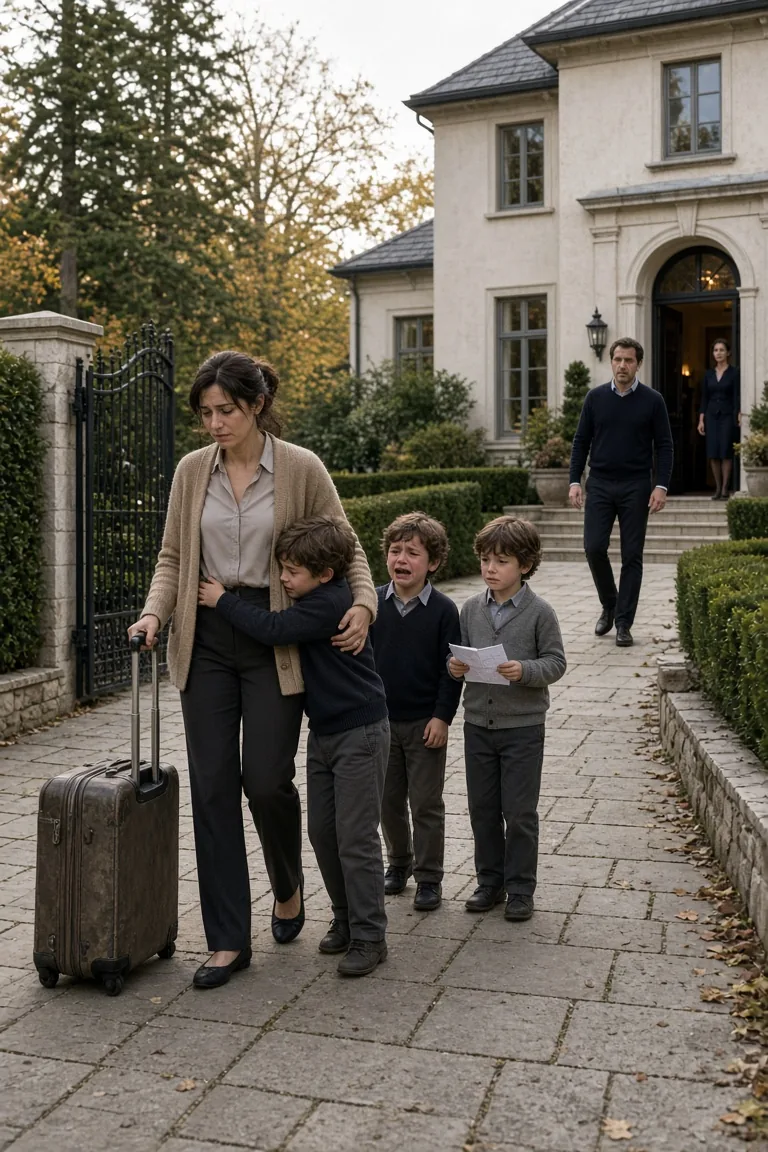
He Told the Nanny to Leave. Then the Triplets Ran After Her. Emilia Conti’s old suitcase made a hard, hollow sound as it rolled down the long stone driveway.
Clack. Clack. Clack.
Each hit against the pavement seemed louder than it should have been, maybe because it kept time with the worst hour of her life.
Behind her, past the iron gates and trimmed hedges, stood the Bellini estate in the hills of Westchester County, New York. It was the kind of house people slowed down to look at from the road, all pale stucco walls and tall windows and expensive quiet.
For three years, Emilia had walked through that front door every morning as if it were part of her own life.
Now she was leaving it with one suitcase.
She didn’t turn around. She knew if she did, she might lose the little control she had left.
Less than an hour earlier, she had been in the parlor setting out the boys’ after-school snacks when Vittoria Rinaldi came in holding a velvet watch box and a look of practiced concern.
Riccardo Bellini was near the fireplace, still in his work clothes, one hand wrapped around his phone. Emilia remembered that detail because he never actually put the phone down, not even when everything shifted.
Vittoria lifted the watch as if presenting evidence in court.
“I found it in Emilia’s suitcase,” she said.
The room went still.
Emilia stared at the watch first, then at Vittoria, then back again. It was one of Riccardo’s collector pieces, a rare watch he kept insured for an amount Emilia could barely imagine.
“That’s not mine,” Emilia said. “I’ve never seen it before.”
Vittoria gave a small smile that never reached her eyes.
“Of course you haven’t.”
Emilia had turned to Riccardo then, waiting for something human. A question. A pause. A sign that three years in his house meant more than one sentence from the woman he planned to marry.
She got none of it.
Riccardo’s jaw tightened. He didn’t yell. That almost made it worse.
He just pointed toward the front hall and said, “Get out.”
The words landed harder than the accusation.
Emilia had opened her mouth to speak, but nothing useful came. How do you defend three years of quiet loyalty in ten seconds? How do you explain that you were the one who got the triplets through fevers, nightmares, winter stomach bugs, and the brutal storms that sent them racing barefoot down the hallway?
She was the one who learned exactly how Eddie liked his grilled cheese cut, how Nico only fell asleep if someone sat in the room until his breathing slowed, and how Leo went quiet when he was scared instead of crying.
She was the one who made up gentle stories about the mother they had never really known, because Riccardo still couldn’t say her name out loud for long.
She had not stolen anything.
But Riccardo had already decided which version of the room he believed.
Then Vittoria reached into her purse, took out a fold of crisp hundred-dollar bills, and dropped them near Emilia’s shoes.
“For the trouble,” she said.
Emilia looked at the money, then at Riccardo.
He didn’t stop her. He didn’t stop any of it.
So she bent down, picked up her suitcase instead, and walked out with every ounce of dignity she could still carry.
Now she was only a few yards from the gate.
Then she heard it.
“Emilia!”
Not one voice.
Three.
She stopped so suddenly the suitcase tipped sideways.
The triplets came running down the driveway in a blur of sweaters and untied sneakers, with old Mrs. Delgado, the longtime housekeeper, hurrying after them and failing badly to catch up.
Edoardo got there first and threw his arms around Emilia’s waist.
“Don’t go,” he said, holding on with the desperate force only children have.
Nicolò came next, already crying hard enough that he could barely speak.
Leonardo didn’t cry.
He held out a folded sheet of paper with both hands.
“Papa has to see this,” he said.
Something cold moved through Emilia’s chest.
She knew the paper immediately.
It was the drawing Leo had made the night before when she found him unusually quiet at the kitchen table. She had sat beside him and asked what was wrong. He hadn’t answered with words. He had answered with crayons.
On the page were four stick figures in front of the house.
Three small boys stood outside the gate.
One woman stood inside.
And next to her, in a child’s uneven handwriting, was the sentence Emilia had not had the courage to show Riccardo because she had prayed it was only fear talking.
When Daddy marries her, you won’t be allowed back in.
Emilia had folded the page and kept it in her apron pocket all day, unsure whether showing it would protect the boys or make things worse.
Before she could speak, the front door swung open.
Riccardo stepped out onto the front walk, irritation already on his face from the boys having run outside.
Then he saw Leo holding out the paper.
He came closer.
His eyes moved from Emilia’s face to Nico’s tears, to Eddie’s grip around her waist, to the crumpled drawing in Leo’s hand.
“Leonardo,” he said, his voice slower now, more careful. “What does it say?”
Leo looked past his father.
Straight at Vittoria, who had just appeared in the doorway behind him.
Then he lifted his chin, tightened his small fingers around the paper, and answered.
Grief can make people confuse control with judgment, especially when trust is being tested where love should be. And children often see the truth in a house long before the adults are ready to hear it.
Part 2: A New Beginning for Emilia
(Part 2)
Leo’s voice was quiet, but every person on the driveway heard him.
“It says Miss Vittoria told us you were sending Emilia away anyway,” he said. “And that we weren’t supposed to tell you she went into Emilia’s room.”
No one moved.
Riccardo looked at his son as if he had not understood the words the first time.
“What do you mean,” he asked, “she went into Emilia’s room?”
Before Leo could answer, Eddie blurted it out the way only a frightened seven-year-old can.
“She had your watch in her hand this morning.”
Nico wiped his face with his sleeve and nodded so hard it almost looked painful.
“She put it in the little zipper pocket,” he said. “She said it was a game, but then she said not to tell.”
For a second, Vittoria actually laughed.
Not warmly. Not nervously.
Dismissively.
“Riccardo, they’re children,” she said. “They’re upset because she’s leaving. They’re confused.”
But something in Riccardo had already shifted. Emilia saw it happen in real time.
He turned to Eddie first. “Where were you when you saw that?”
“On the upstairs landing,” Eddie said. “We were supposed to wash our hands before lunch.”
Riccardo turned to Nico. “And you saw the same thing?”
Nico nodded. “She saw me, and she shut the suitcase fast.”
Then Riccardo looked at Leo, the quietest of the three, the one who usually spoke only after he was sure of himself.
“Why didn’t you tell me before?”
Leo swallowed. “Because she said if we made trouble, Emilia would have to go sooner.”
That was when Mrs. Delgado finally caught up, one hand pressed to her chest.
“I should have spoken earlier,” she said, breathless and ashamed. “I saw Miss Vittoria come out of the nanny wing this morning. I thought maybe she was looking for you. Then I heard her tell the boys not to repeat grown-up conversations.”
Vittoria’s expression sharpened.
“This is ridiculous.”
Riccardo didn’t answer her. He was staring at the house now, but not really seeing it. Emilia knew that look. It was the face of a man replaying the last hour and realizing how much of it he had accepted because it was convenient.
He turned back to Vittoria.
“How did you know to check Emilia’s suitcase?”
Vittoria crossed her arms. “I had a feeling.”
“A feeling,” he repeated.
The words sat there between them.
Riccardo pulled his phone from his pocket and made one call to his security manager. The Bellini house had cameras on the exterior, in the main hall, and at the upstairs landing. Emilia had forgotten about them entirely. Vittoria, apparently, had too.
They all went inside.
No one sat down.
The footage came up on the monitor in Riccardo’s study within minutes.
It showed the upstairs landing just before noon. The boys came out of the playroom. Emilia was downstairs in the kitchen. Vittoria walked down the hall carrying something small in one hand. She stopped outside Emilia’s room, glanced once over her shoulder, and went in.
A minute later, she came out empty-handed.
Another camera from the main hall showed her later returning to the parlor with the velvet watch box.
There was no explaining it away.
Vittoria tried anyway.
“This is absurd,” she said. “I was protecting this family. That woman has made those boys too attached. They run to her for everything. They don’t listen to me, and after the wedding that would have had to change.”
The room went quiet again, but this time the silence belonged to her.
Riccardo looked at her for a long moment, and when he spoke, his voice had gone flat.
“So you planted a watch worth nearly a million dollars on the woman who has raised my sons for three years because you were jealous of the place she held in this house.”
Vittoria lifted her chin. “I was trying to create boundaries.”
“No,” Riccardo said. “You were trying to remove someone my children trust because you couldn’t control them with her here.”
He stepped aside and pointed toward the front hall, the same way he had pointed at Emilia.
“You need to leave.”
Vittoria stared at him, waiting for him to change his mind.
He didn’t.
When she finally walked out, she did it without dignity, angry tears running down a face that had looked composed an hour earlier.
Then Riccardo turned to Emilia.
The boys had pressed themselves close to her again, as if they were afraid one wrong sentence would make her disappear.
“I was wrong,” he said.
It was a simple sentence, but it cost him something to say it.
Emilia looked at him steadily. “You were.”
He nodded once. “I should have asked questions. I should have trusted what I know about you. I didn’t.”
“No,” she said softly, “you trusted what was easiest in the moment.”
He lowered his eyes. That hurt him more because it was true.
Then he surprised her by kneeling in front of the boys first.
“I’m sorry,” he told them. “All three of you. You tried to tell the truth, and I almost didn’t hear it.”
Leo reached for his father’s sleeve.
“Can Emilia stay?”
Riccardo stood and faced her again. “I want to ask you to stay,” he said. “But I know I don’t get to act like nothing happened.”
Emilia glanced at the suitcase still by the door.
For three years, she had given that house patience, steadiness, and care. She had earned more than a rushed apology at the end of a disaster.
“I’ll stay tonight for the boys,” she said. “They need calm after this. Tomorrow, we talk about whether I come back to work, and if I do, it will be with respect, clear terms, and no confusion about where I stand.”
Riccardo nodded immediately. “Whatever you need.”
That evening, the house felt stripped down to its truth.
Mrs. Delgado reheated the soup no one had touched earlier. Nico finally stopped crying when Emilia sat beside him. Eddie wouldn’t let go of her hand through dinner. Leo brought the drawing back and asked if they could throw it away tomorrow.
“Tomorrow,” Emilia said, smoothing his hair.
Later, when the triplets were in bed, Riccardo stood in the doorway of their room while Emilia read the last page of a storybook in a low, steady voice. The boys drifted off one by one, secure again because the person who had always protected them was still there.
When she looked up, Riccardo was still standing there, quiet and humbled.
He didn’t ask for forgiveness that night.
He seemed to understand that trust, once thrown out a front door, does not walk back in just because someone finally sees the truth.
But as the house settled and the boys slept, one thing had changed for good: the children had spoken, the lie had broken, and the person Riccardo should have believed from the beginning was still the one keeping his home together.
A weary nanny rolls a suitcase down a wealthy hillside estate driveway as three young triplet boys run after her while their father appears at the open front door.
Discover more heartwarming stories and emotional moments on our main editorial page.
The Four-Year-Old Who Told — An Inspiring Story — An Inspiring Family
Read Full Story ➡️