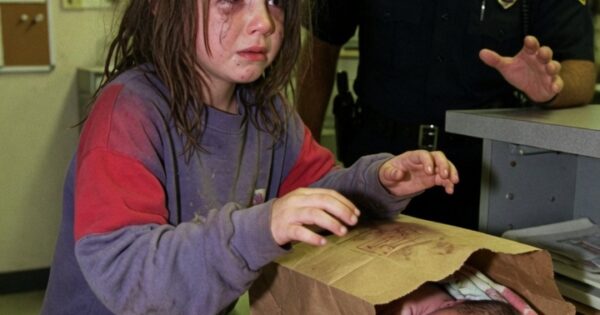
Locked out daughter waits outside her own home
June pressed her school key into the lock with both hands, because her fingers were too cold to feel the metal.
Rain ran off her hood in steady little streams.
Her blue backpack sagged against her knees. One sock had slipped under her heel. The paper lunch bag in her side pocket had gone soft and gray from the weather.
The key went in.
It would not turn.
June was eleven, small enough that strangers still asked if she was eight, and tired enough that afternoon to think maybe she had done it wrong.
She pulled the key out.
Wiped it on her sleeve.
Tried again.
Nothing.
Inside the house, the hallway light was on.
She could see it through the thin curtain beside the door. Yellow. Warm. Normal.
That was what made it worse.
She knocked once.
Then twice.
Then with the side of her fist.
“Grandma?”
Her voice got swallowed by rain and passing tires.
Across the street, Mr. Avery’s dog barked from behind a fence. A delivery van rolled past, spraying water against the curb. June stepped back so the splash would not hit her shoes, but it did anyway.
At 3:42, she called her mother.
No answer.
Elena was on the surgical floor at County Memorial, six hours into a double shift, with her phone sealed in a locker under a buzzing fluorescent light.
June knew that rule.
No phones near the unit.
So she waited.
At 4:15, her notebook pages curled at the edges.
At 4:50, she stopped knocking because her knuckles hurt.
At 5:30, she sat on the porch step with her backpack between her knees, trying to keep her spelling folder dry under her jacket.
The rain got into everything.
Her sleeves.
Her collar.
The little gap between her shoe and her sock.
She kept looking at the front window.
Once, the curtain moved.
Just a little.
June stood up so fast her backpack slid off one shoulder.
“Grandma?”
No one came.
By 6:10, the porch bulb clicked on.
June almost cried from relief.
The door opened three inches, then wider.
Patricia stood there in house slippers, holding a white mug with both hands. Her hair was pinned neatly. Her sweater was dry. Behind her, the television murmured low, and the house smelled like lemon cleaner and warmed bread.
June took one step forward.
“Grandma, my key is broken.”
Patricia looked past her at the rain, as if June had tracked it there on purpose.
“It isn’t broken.”
June’s mouth stayed open.
“I don’t understand.”
Patricia set the mug on the narrow table by the door. Her hand was steady.
“Your mother should have prepared you.”
“For what?”
Patricia sighed. Not sad. Tired.
Like June had interrupted something.
“We made a family decision.”
June hugged the backpack strap with one wet hand.
“What decision?”
“You and your mother don’t live here anymore.”
June blinked.
Rain tapped on the porch roof.
A car rolled by slow enough for the driver to glance over, then keep going.
“But my room is upstairs.”
“No, sweetheart. It was upstairs.”
That word hurt more than the lock.
Was.
June looked at the little brass key in her palm. Her father had put a purple rubber cover on it years ago so she would not lose it. He had said, “This gets you home.”
Patricia watched her look at it.
Then she held out a plastic grocery bag.
Inside were June’s rain boots, her pink hairbrush, and the framed photo she kept beside her bed.
Not clothes.
Not school books.
Not the stuffed rabbit with one missing ear.
Just things that could be handed over fast.
“Where’s Mom?” June asked.
“At work, I assume.”
“Does she know?”
Patricia’s jaw tightened.
“She knows enough.”
June did not cry then.
Children have a place they go when crying stops helping.
She took the bag.
Her fingers shook so badly the handles slipped twice.
The door closed before she reached the sidewalk.
At 8:27, Elena found her daughter in the public library restroom two blocks away, standing under the hand dryer because it was the only warm air she could find.
June’s lips were pale.
Her shoes squeaked.
The librarian had wrapped her in a lost-and-found cardigan that smelled faintly of dust and peppermint gum.
Elena knelt on the tile.
“Baby.”
June stared at her mother’s hospital badge, still clipped to her scrub top.
“Did we do something bad?”
Elena could not answer right away.
Something in her went quiet.
Not calm.
Quiet.
The kind of quiet that comes before a person decides what she will never allow again.
They slept that night in Elena’s old sedan behind the hospital, under the orange parking lot light. June curled in the backseat with two cafeteria blankets and a cup of water between her hands.
The next morning, Elena went to the white house on Bell Street.
Her scrubs smelled like stale coffee and disinfectant.
Patricia opened the door before Elena knocked a second time.
“You should have called first.”
“My daughter waited five hours in the rain.”
“She’s dramatic.”
Elena looked past her mother into the hallway.
Family photos were still on the wall.
June’s school portrait was gone.
“Where are her things?”
“Safe.”
“That wasn’t my question.”
Patricia folded her arms.
“You were supposed to understand by now. You work too much. You’re barely home. This house needs peace.”
“This house?”
Patricia’s eyes sharpened.
“Your father wanted stability.”
Elena almost laughed.
It came out as one breath.
“My father wanted June to have a home.”
Patricia reached for the door.
“Then maybe you should have been a better mother.”
Elena nodded once.
“Alright.”
She said it so softly Patricia seemed disappointed.
No argument.
No begging.
No scene for the neighbors.
Elena took June to a motel with a broken ice machine and a heater that clicked all night. She bought socks from a gas station and washed June’s uniform in the sink with travel soap.
For three days, Patricia did not call.
On the third afternoon, a registered letter arrived at Bell Street.
It came in a stiff cream envelope.
Patricia signed for it at the door, annoyed by the rain starting again.
Then she opened the first page and read the line her late husband had written in his own hand: The house belongs to June when Elena says she is ready, and Patricia has no legal right to remove either of them.
The letter that changed the house
Patricia read the sentence three times before her hands began to move.
Not shake exactly.
Move.
Like her body was trying to put the paper down before her pride understood what it said.
The rain had started again outside. It tapped against the front window, the same window June had stared at for hours.
Patricia sat at the dining table in the good chair, the one no one used unless company came.
The letter lay open beside her tea.
It was from Martin Reeves, the attorney who had handled Elena’s father’s affairs after he passed on.
Patricia had avoided Martin for years.
He had a plain voice and a way of looking over his glasses that made lies feel underdressed.
The letter was short.
The house was not Patricia’s.
It had never been hers alone.
Elena’s father had left Patricia the right to live there, but only if Elena and June were also allowed to live there safely. If Patricia tried to force them out, the trust could remove her from the property.
There were copies attached.
The deed.
The trust agreement.
A handwritten note.
Patricia touched that note last.
Her husband’s handwriting was uneven from the last months of his illness, but the words were clear.
Pat, don’t punish Elena for surviving what we didn’t understand. And don’t ever make June feel like a guest in her own home.
Patricia pushed back from the table.
The chair scraped the floor.
For the first time in three days, she looked at the bare square on the hallway wall where June’s school picture had been.
She had taken it down because she thought it made the house easier to claim.
Now the empty space looked childish.
Small.
Cruel in a way she had not let herself name.
Her phone rang at 4:06.
Martin Reeves.
Patricia let it ring once, twice, then answered.
“Mrs. Vale,” he said. “You received my letter.”
“This is a family matter.”
“It became a legal matter when an eleven-year-old was locked out.”
Patricia gripped the table edge.
“Elena can’t manage her life.”
“That is not what the documents ask me to decide.”
“You don’t know what she’s like.”
“I know June was found in wet clothes in a public building after dark.”
Patricia went silent.
The refrigerator hummed.
Somewhere upstairs, a loose branch tapped the siding.
Martin’s voice stayed even.
“Elena has not asked for punishment. She asked for access to her daughter’s belongings and a safe transfer of the property documents.”
“She wants the house.”
“No,” he said. “She wants her child to stop being afraid of a front door.”
That was the line that finally reached Patricia.
Not because it was gentle.
Because it was accurate.
At the motel, Elena sat on the carpet with her back against the bed, sorting June’s damp school papers into piles.
Math.
Reading.
Forms to replace.
June lay on the mattress under a thin blanket, watching her mother smooth every wrinkled page with the side of her hand.
“Are we homeless?” June asked.
Elena stopped.
The heater clicked.
“No.”
“But we don’t have our house.”
Elena turned around slowly.
“We have each other. And we have help coming.”
“From who?”
“From Grandpa.”
June frowned.
“He’s not here.”
Elena looked at the motel door, then back at her daughter.
“Sometimes people protect you before you know you’ll need it.”
The next morning, Martin met Elena outside the house with a locksmith, a county officer, and a folder tucked under his arm.
Elena wore the same black coat she had worn to her father’s last hospital appointment. The sleeves were frayed. Her hair was pulled back badly. She had not slept much.
June stood beside her, holding the purple-covered key.
She had brought it without being asked.
Patricia opened the door.
For a moment, nobody spoke.
The house smelled like lemon cleaner again.
Elena hated that smell now.
Martin cleared his throat.
“Mrs. Vale, we’re here to restore access and collect the child’s belongings.”
Patricia looked at June.
June looked down at her shoes.
That did more damage than anger would have.
Patricia stepped aside.
The locksmith changed the lock while June went upstairs with Elena.
Her room looked half-erased.
The bed was stripped.
The rabbit was in a cardboard box.
Her school ribbons were folded inside a pillowcase, like someone had tried to make rejection look tidy.
June picked up the rabbit and pressed its flat ear against her cheek.
Elena turned away because her face would have scared her daughter.
Downstairs, Patricia stood near the kitchen doorway.
“I thought structure would help her,” she said.
Elena looked at her.
“Standing in rain is not structure.”
Patricia swallowed.
“I thought if you had nowhere to go, you’d finally listen.”
“To what?”
“To me.”
There it was.
Small.
Ugly.
Ordinary.
Not a grand reason. Not a hidden danger. Just control dressed up as concern.
Elena did not yell.
She was too tired to give her mother that kind of power.
“You can stay here until Martin finishes the trust process,” she said. “Then you’ll move to Aunt Carol’s place, or wherever you choose.”
Patricia’s face hardened.
“You’d put me out?”
Elena looked at June on the stairs, clutching the rabbit, watching every adult like the room might tilt again.
“No,” Elena said. “You did that. I’m just making sure my daughter never has to ask permission to be home.”
Six weeks later, June’s picture was back on the hallway wall.
The porch light was replaced.
The lock turned smoothly.
June still paused before opening the door sometimes. Elena noticed but did not rush her. Healing, she learned, had its own pace.
One evening, June came home from school with rain in her hair and mud on one shoe. She put her key in the lock, turned it, and stepped inside.
Elena was in the kitchen making soup from a packet, still in scrubs, still tired.
June stood in the doorway.
Then she smiled a little.
“It worked.”
Elena nodded.
“Every time.”
If a family elder says they are protecting a child, how far should that power ever be allowed to go? Share this story gently if it made you think of a child who deserved a safer door.