
police station baby: The Girl Who Walked In Barefoot
The digital clock above the reception desk read 9:48 p.m. when Officer Caleb Warren heard the front door of the Cedar Hollow police station open.
It was a small sound. Not a shove. Not panic. Just the tired scrape of glass against its frame.
Caleb looked up from a stack of reports and saw a child standing under the fluorescent lights.
She was barefoot.
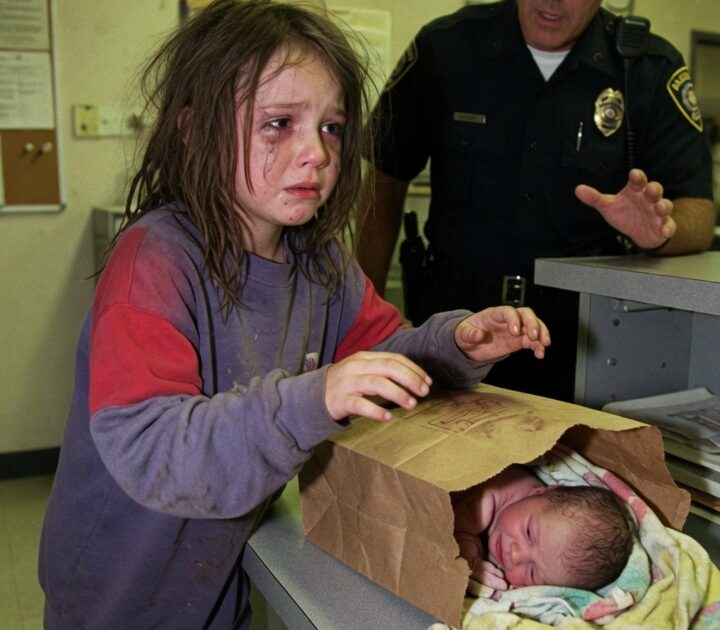
At first, that was all his mind could hold. Bare feet on the polished tile, toes curled from cold, dust around her ankles like she had crossed half the town without thinking about pain. Her pants were too big and tied with a pink shoelace. Her sweater had one sleeve stretched longer than the other.
In her arms, she held a crumpled brown paper bag.
“Hey,” Caleb said softly.
The girl did not move.
He had two daughters who lived three hours away with their mother. He knew the look children got when they had already used up all their crying. This little girl had tear tracks running through the dust on her cheeks, narrow and clear, as if someone had drawn lines down her face.
“You’re safe here,” Caleb said. “Can you tell me your name?”
Her fingers tightened around the bag.
“Lily.”
“Okay, Lily. I’m Caleb.” He came around the desk slowly. “Are you hurt?”
She shook her head too fast.
The bag rustled.
Caleb stopped.
The station felt suddenly too quiet. The old soda machine hummed near the hallway. Somewhere behind him, a printer clicked once and went still.
“What’s in the bag, Lily?”
Her lower lip trembled, but she forced the words out.
“My baby brother.”
Caleb’s hand went to his radio before he even decided to move.
“Is he breathing?”
“I don’t know.” Her voice broke into a whisper. “He was. Then he got quiet.”
Caleb crouched so he wasn’t towering over her. “Can I see him?”
For one second, Lily looked toward the dark windows behind him, as if someone might be standing outside, watching. Then she held the bag forward.
It looked too light.
That was the thing Caleb would remember later. The terrible lightness of it. A grocery bag was not supposed to hold a life.
He took it with both hands, supporting the bottom. The paper was soft from being carried too long. Along one seam, there was a faint damp stain. Lily’s arms fell to her sides, and her fingers stayed curved, still shaped around what she had been holding.
Caleb set the bag on the desk and opened it carefully.
Inside were old cotton cloths. A faded towel. A woman’s blue diner apron folded around something tiny.
Then he saw the baby.
A newborn boy.
Small. Pale. Lips faintly blue. One fist near his cheek, fingers no bigger than Caleb’s thumbnail.
For a second, Caleb did not breathe.
Then the baby’s chest rose.
Barely.
“Dispatch, I need EMS to Cedar Hollow PD now,” Caleb said, his voice low but sharp. “Newborn infant, weak breathing, possible exposure.”
Lily flinched at the radio crackle.
“No,” she whispered.
Caleb looked at her. “Lily, he needs help.”
“She said no ambulance.”
“Who said that?”
Lily pressed both hands over her mouth.
A second officer, Marla Kent, came through from the back room. The moment she saw the desk, her face changed. She moved fast, bringing the emergency blanket, the infant mask, the small kit they almost never used.
Caleb touched the baby’s foot. Cold.
“Lily,” he said, “where is your mom?”
The girl’s eyes filled again, but no sound came out.
“Is she hurt?”
Lily stared at the bag.
Marla wrapped the baby without lifting him more than necessary. “Stay with me, little man,” she murmured, not to be heard, just to keep her own hands steady.
Caleb kept his eyes on Lily. “You did the right thing coming here.”
Lily shook her head.
“I wasn’t supposed to.”
“Why not?”
“Grandma said people would ask.”
“What would they ask?”
Lily looked at the door again.
This time Caleb saw what she was watching for. Not a stranger. Not a monster from a child’s imagination. A car. A familiar adult. Someone who could take her back before the truth was spoken out loud.
The ambulance siren began far off, thin at first, then growing.
Lily stepped closer to the desk. Her dirty toes touched the metal base. She pointed at the apron around the baby.
“There’s a paper in there,” she said.
Marla glanced up. Caleb moved the cloth with two fingers and found a folded clinic discharge sheet tucked beneath the apron. It was creased, damp at one corner, and signed only six hours earlier.
The mother’s name was Tara Whitcomb.
The baby’s last name was blank.
Caleb knew that name. Everyone in Cedar Hollow knew Tara Whitcomb, the waitress at Nell’s Diner who always worked double shifts and never let her daughter leave without a sandwich wrapped in napkins.
He looked back at Lily.
“Where is your mother?”
The siren was close now. Red light flashed across the station windows.
Lily’s voice dropped so low Caleb almost missed it.
“She’s in Grandma’s laundry room,” she said. “She won’t wake up either.”
Then she grabbed Caleb’s sleeve with both hands and whispered, “Grandma told me to say I found him by the dumpsters.”
What Lily’s Paper Bag Forced a Whole Family to Admit
Caleb did not wait for the ambulance doors to open before he moved.
He handed the folded clinic paper to Marla, pointed to Lily, and said, “Do not let anyone take her out of this building unless I say so.”
Marla understood before he finished.
Lily stood by the desk, shaking so hard the oversized sweater slid off one shoulder. When the paramedics came in, she tried to reach for the baby, but Caleb knelt in front of her.
“They’re helping him breathe,” he said. “You did that. You got him here.”
Her eyes stayed on the tiny bundle.
“He’s my brother,” she said, as if someone had already tried to argue.
“I know.”
The words mattered. Caleb could feel it. Lily’s face loosened a little, just enough for one breath.
Within minutes, Caleb and another officer were at the small white house behind Second Baptist Church, where Dolores Whitcomb had lived for thirty-two years. Everyone called her Mrs. Whitcomb at church. She arranged casseroles, corrected people’s grammar in sympathy cards, and kept a spotless front porch with plastic geraniums in a green planter.
The back door was unlocked.
Inside, the air smelled of bleach and wet towels.
“Tara?” Caleb called.
No answer.
They found her in the laundry room on a folded quilt beside the dryer. She was conscious, but barely. Her face was gray with exhaustion. One hand was pressed against her stomach, the other curled around a baby sock.
When she saw Caleb’s uniform, tears slipped sideways into her hair.
“Lily?” she whispered.
“She’s safe. The baby is with EMS.”
Tara closed her eyes. Not relief exactly. Something weaker. Something that had waited too long.
At the hospital, the truth came out in pieces.
Tara had given birth earlier that evening at the women’s clinic in Millfield after hiding the pregnancy for months under loose diner uniforms. She had not hidden it because she was ashamed of the child. She had hidden it because her mother had made shame feel like rent she owed every day.
Dolores had driven her home instead of letting her stay for observation. She told Tara that Cedar Hollow did not need another story to chew on. She said Lily had already suffered enough whispers without “a fatherless baby” becoming Sunday talk.
Tara had argued. Not loudly. She was too tired for loud. She wanted to go back to the clinic when the baby’s breathing sounded wrong.
Dolores refused.
“She said if I called anyone, she’d tell them I was unfit,” Tara told Caleb the next morning, her voice rough from crying and medicine. “She said they’d take both my children. She said Lily would end up somewhere worse because of me.”
Caleb had heard many threats in his years on duty. Some came with fists. Some came in church clothes, over clean kitchen counters, spoken by people who knew exactly which fear would hold a tired person still.
Lily had been listening from the hallway that night. She had heard her mother crying in the laundry room. She had heard the baby make a small choking sound and then go quiet.
So she did the only thing a seven-year-old could think to do.
She put him in the paper bag because it had handles. She wrapped him in the apron because it smelled like her mother. She walked three blocks barefoot because she could not tie her shoes while holding him, and she was afraid that if she took too long, he would stop moving forever.
When Dolores arrived at the police station just after midnight, she came in wearing a buttoned cardigan and a face full of injury.
“That child is confused,” she said. “She has always had an imagination.”
Lily was sitting in Marla’s office with a cup of cocoa she had not touched. She heard her grandmother’s voice and tucked her feet under the chair.
Caleb stepped into the hallway and closed the door behind him.
“No,” he said. “She is tired. There’s a difference.”
Dolores looked past him toward the office. “I am her family.”
“So is her mother. So is that baby.”
Her mouth tightened. “You don’t understand what people do to girls who make mistakes.”
Caleb thought of Tara on the laundry room floor. Lily’s torn sleeve. The newborn’s little chest fighting under a plastic mask.
“I understand what people do when they’re more afraid of gossip than grief,” he said.
The baby survived.
It was not neat. Nothing about it was neat. Tara had a long recovery, social workers came, and Dolores had to answer questions she could not smooth over with folded hands and a soft voice. For a while, Lily and the baby stayed with Tara’s cousin, a school bus driver named Renee, who had been quietly leaving groceries on Tara’s porch for months.
When Tara was strong enough, she sat beside Lily in the hospital nursery and told her the baby’s name.
“Jonah,” she said.
Lily touched the glass with one finger. “Does he know I carried him?”
Tara pressed her palm over her daughter’s hand.
“He will,” she said. “I’ll tell him until he’s sick of hearing it.”
Weeks later, Caleb saw them at Nell’s Diner. Tara moved slowly, but she was upright. Lily wore red sneakers with bright white laces. Baby Jonah slept against Tara’s chest, round-cheeked and warm.
Dolores was not with them.
Some people in town said she had only been trying to protect her daughter from shame. Others said she had nearly let pride bury a family.
Caleb never joined those conversations. He only remembered a barefoot girl under fluorescent lights, holding a paper bag as carefully as prayer.
When fear and family pride put children in danger, where should forgiveness end and accountability begin?