
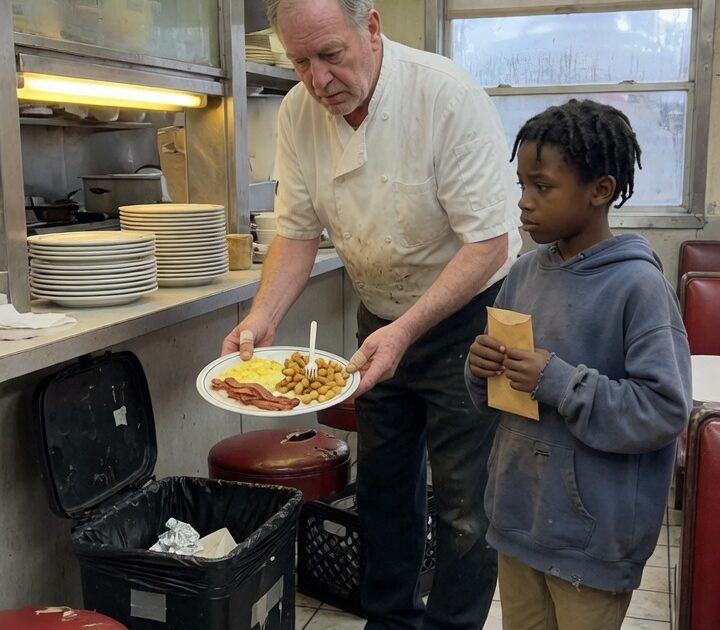

This old chef kindness begins with a hungry boy beside a diner trash can, a plate taken from his hands, and one cook who refuses to pretend he did not see it. Twenty years later, the same boy returns as a wealthy man holding ownership papers, but the building is not the only thing he has come to claim. A torn hospital receipt, a missing gold ring, and a man declared dead in a morgue all lead back to the same breakfast counter, where one quiet choice becomes the only honest witness left.
Part 1: Old Chef Kindness and the Diner Secret
The chipped white plate shook in Marcus Reed’s hands as the manager pried it loose and scraped the last eggs into the trash. He was ten, maybe eleven, standing beside the dented can near the counter with one sleeve hanging below his wrist. He did not cry, and that was what Frank Doyle remembered long after the breakfast rush moved on.
“Out,” Burt Hensley said, low enough for the room to pretend it had not heard.
Marcus looked at the floor. His fingers stayed curled around a small brown envelope pressed against his ribs.
Frank stood behind the pass with a pan in his hand and bacon grease popping against his forearm. He had worked at Rowley’s Diner for thirty-two years, long enough to know when a room had made its decision. People lowered their eyes. Forks kept moving. The manager straightened his tie like he had restored order.
Frank took a clean plate from the warmer.
The boy was outside by then, near the alley door, where the smell of dishwater met the sour steam from the trash. Frank stepped out carrying two eggs, toast, and potatoes with the burned edges scraped off. He set the plate on an overturned milk crate.
“You can eat,” he said.
Marcus stared at the food first, then at Frank’s hands. The envelope had a crease down the middle, and a bit of gold chain showed at the open corner.
“I got money,” the boy said.
“I didn’t ask.”
The boy ate standing up. Not fast. Careful, as if chewing too loudly might make someone take the plate away again. Frank waited until he was done, then wrapped two biscuits in wax paper and pointed him toward St. Anne’s shelter three blocks over.
The missing gold ring receipt
When Frank went back inside, Burt was washing his hands at the small sink by the office.
“Don’t make a habit,” Burt said.
Frank looked at the trash can near the counter. The lid was still swinging.
Twenty years later, the same trash can was painted black, the counter had a new laminate top, and Frank’s knees made a small complaint every time he lifted a stockpot.
He was slicing onions when the black car stopped outside.
Nobody in Rowley’s owned a car like that. The engine went quiet without a rattle. A man stepped out in a charcoal coat, tall, clean-shaven, with close-cut black hair and a face Frank knew before he could place it. The man carried a folder in one hand and did not look at the booths, the pie case, or the framed reviews on the wall.
He looked at the trash can.
The new manager, Denise, hurried over with the smile she used for inspectors.
“Can I help you?”
The man opened the folder and laid papers on the counter.
“I own the building now.”
A fork tapped against a plate, then stopped. Frank wiped his hands on his apron.
Denise blinked. “I’m sorry?”
“The sale closed this morning.” He slid one page toward her. “I asked that no one be told until I came in.”
Frank stepped out from the kitchen. The man turned at the sound of his shoes.
“Mr. Doyle,” he said.
Frank knew the voice then. Older, lower, but still careful with each word.
“Marcus.”
The room went still in that special way public rooms do when everyone wants to hear and no one wants to be caught listening.
Marcus nodded once. “I wasn’t sure you’d still be here.”
“Neither was I.”
A corner of Marcus’s mouth moved, not enough to be a smile. He tapped the folder with one finger, but his eyes went back to the trash can.
“I came for that first.”
“The can?”
“The place beside it.”
Denise gave a nervous laugh. “We changed the floors twice since then.”
Marcus crouched anyway. His coat brushed the metal foot rail. He reached under the counter lip and felt along the old seam where the wall met the baseboard.
Frank wanted to tell him there would be nothing there. Twenty years of mop water, repairs, spilled coffee, and other people’s shoes had passed over that spot.
Marcus’s hand stopped.
He pulled free a thin strip of brown paper, stiff with age, folded tight behind the molding. The same color as the envelope the boy had held against his ribs.
Frank’s mouth went dry.
Marcus unfolded it. Inside was a corner of a hospital receipt and a torn imprint from a missing property form. The ink had faded, but one line remained readable: gold wedding ring, initials D.R.
Frank heard the old bacon grease again, the little pops against skin.
Marcus did not look up. “My mother told me she gave me an envelope that morning. A ring, a receipt, and a name. I remembered breakfast. I remembered him taking the plate. I didn’t remember losing this.”
“Burt,” Frank said.
Marcus’s hand closed around the paper.
“He’s in St. Agnes now,” Marcus said. “Or he was. They called him dead this morning.”
A woman in the last booth whispered, then covered her mouth with her napkin.
Marcus opened his phone. “A morgue nurse tried to take a ring off his hand. He moved.”
Frank leaned against the counter.
Marcus turned the screen toward him. On the phone was a photograph of a gold ring on a man’s hand, and beneath the morgue tag was the name Burt Hensley.
Part 2: The Ring in the Morgue Led Back to One Breakfast
Frank’s fingers left a damp print on the counter where he caught himself. For a few seconds, he could only look at the phone in Marcus’s hand, at the swollen old knuckles, the gold ring, the tag with Burt Hensley’s name clipped beneath them.
The diner noise came back in pieces. A spoon against ceramic. The grill fan. Denise saying, “Frank?” from very far away.
Marcus lowered the phone.
“He said your name,” Marcus told him. “When he woke up.”
Frank shook his head once. “Mine?”
“Frank Doyle. Then he asked if the boy had eaten.”
That sentence hit the room harder than shouting would have. The woman in the last booth put her napkin down. Denise stopped pretending to sort receipts.
Marcus slid the torn hospital paper beside the ownership documents. The brown paper looked small there, almost useless, except every person at the counter seemed to know better.
“My mother died two days after that morning,” he said. “I was in county care before anyone found my aunt’s number. By then the envelope was gone.”
Frank looked at the old strip of paper. “I should’ve gone after him.”
“You fed me.”
“I let him walk back in.”
Marcus did not answer.
His phone buzzed on the counter. He turned it so Frank could see the caller ID: St. Agnes Hospital.
Marcus put it on speaker.
A woman’s voice came through, tight and professional at first. “Mr. Reed? This is Clara Winslow from the night unit. Mr. Hensley is awake. He’s asking for water, a lawyer, and the man from the diner.”
Denise whispered, “Lord.”
Marcus looked at Frank. Not asking. Waiting.
Frank removed his apron. His hands moved slower than they used to. He folded the apron once, then again, and set it beside the grill where he had stood most of his adult life.
At St. Agnes, the hallway smelled of disinfectant and burned coffee left too long on a hot plate. Marcus walked ahead, but not fast. Frank noticed that. The boy who had eaten beside the alley had learned not to rush into rooms where people could take things.
Clara met them outside a curtained bay. She was in her fifties, gray at her temples, with a plain wedding band and no makeup under the harsh lights.
“I was wrong to touch it,” she said before Marcus spoke. “I thought he was gone. I saw the ring and…” She swallowed. “My son needs rent money. That’s not an excuse.”
Marcus studied her for a beat. “Did you take it?”
“No.”
“Then don’t make me your punishment.”
She looked down.
Inside the bay, Burt Hensley lay propped against thin pillows, smaller than Frank remembered. His hair was white. His cheeks had collapsed inward. The gold ring sat on the tray table inside a plastic specimen cup, sealed and labeled.
Burt saw Frank first.
“You got old,” Burt rasped.
“So did you.”
A sound came from Burt that might have been a laugh if it had any strength in it. Marcus stepped closer. Burt did not meet his eyes.
Marcus picked up the cup. “This was my father’s ring.”
Burt stared at the ceiling tile. “Wasn’t doing him any good.”
Frank took one step forward, then stopped. Marcus lifted one hand, asking him not to.
“Say the rest,” Marcus said.
Burt’s mouth tightened.
Clara stood by the curtain, holding a clipboard against her chest.
Burt turned his face toward the wall. “Your mother came in asking about Donovan Reed after the construction accident. She had you with her. She was scared. Had papers. Ring. Said someone told her Rowley’s would know where to find a cousin.”
“My mother trusted you?”
“She trusted anybody who looked like they knew the rules.”
Marcus set the cup down.
Burt licked his lips. “I worked nights here then. Porter. Sometimes security. I knew unclaimed property sat in drawers for months. Your father died before anyone called family. I took the ring. Later I saw your mother at the diner. Saw the envelope.”
Frank shut his eyes briefly.
“You took it from a child,” Marcus said.
Burt’s hand twitched on the blanket. “I took it off the counter after Frank dragged you outside. You dropped it when I grabbed the plate.”
“No,” Frank said quietly. “He didn’t drag me anywhere.”
Burt looked at him then. For the first time, he seemed smaller than the bed rails.
Marcus picked up the ring again. “You let me spend years thinking my mother left me with nothing.”
“I figured you were gone anyway.”
The words lay there, plain and ugly.
Marcus’s face did not move. That was what Frank noticed. No scene. No raised voice. Just a man standing with the thing that had been stolen from a boy.
He turned to Clara. “Call the hospital administrator. Then call the police liaison. I want this handled on record.”
Burt made a wet sound. “You’re not taking me to court over an old ring.”
“No,” Marcus said. “I’m taking you to court over the records you falsified.”
Burt’s eyes shifted.
There it was. The second piece.
Clara opened a drawer and removed a copied intake sheet. She handed it to Marcus without a word. Frank saw Burt’s old signature on the line marked no next of kin present.
Marcus read it. Then he folded the paper with the same care he had used in the diner.
Back at Rowley’s, Denise had locked the front door early. Staff sat in booths, waiting without admitting they were waiting.
Marcus placed the ring on the counter near the trash can.
“I bought this place to close it,” he said.
Frank looked at him.
“I wanted the sign down by Friday. I wanted Burt’s office stripped to the studs. I wanted the whole block to see it.”
Denise covered her mouth with one hand.
Marcus turned the ring once with his fingertip. “Then I saw you still worked here.”
Frank had no speech ready. He had spent his life with short orders, not speeches.
Marcus opened the ownership folder and removed a second packet. “The diner stays open. Employee trust. Denise runs it if she wants. Frank gets the back booth for life and no more dish shifts.”
Frank gave a short, broken laugh. “I still make better soup than any of them.”
“I know,” Marcus said. “But you can sit down while you insult it.”
The room breathed again.
Two weeks later, the old trash can was gone. In its place stood a small wooden shelf with no plaque, no framed story, no grand display. Just a clean plate and a folded paper sleeve for biscuits.
Marcus came in once a week. Sometimes he sat with Frank. Sometimes he sat alone, turning his father’s ring in his palm.
He never visited Burt.
When Clara wrote him a letter of apology, he did not answer it for eleven days. Then he mailed back a rent check made out to her landlord, with a note that said only, Pay it forward without taking from anyone.
Was Marcus right to spare the people who failed him once he had the power to ruin them, or did mercy let them keep too much?


