

Part 1: missing toddler story on the highway shoulder
Officer Daniel Reese first noticed the child because the boy did not look toward traffic.
Most children that age flinched when a semi passed too close. They covered their ears. They cried. This little boy just kept walking along the gravel shoulder, one foot in front of the other, his dirty shirt hanging almost to his knees and his bare toes gray with dust.
Daniel slowed his patrol car.
It was late afternoon, the kind of heat that made the road shine like water. Cars moved past in hard bursts of wind. A paper cup rolled in the ditch, stopped, then rolled again.
The boy was maybe three. Maybe not even that.
Daniel parked ahead of him and stepped out slowly, one hand raised where the child could see it.
“Hey, buddy,” he said. “You okay?”
The boy stopped.
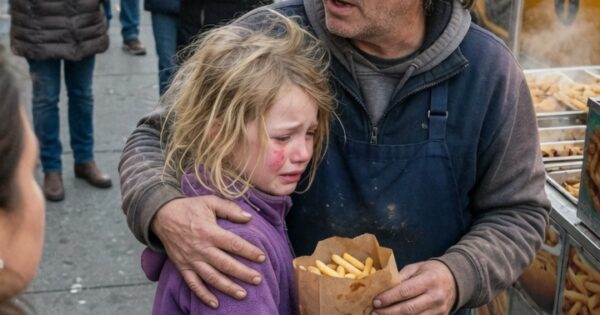
He had dried blood under one nostril, a small cut near his eyebrow, and a face so still it made Daniel’s stomach tighten. Not calm. Not brave. Just used up.
A blue sedan passed without slowing.
Daniel crouched on the hot shoulder. “My name’s Dan. Can you tell me yours?”
The child stared at the badge, then at Daniel’s boots. His bottom lip moved, but no sound came out.
“That’s all right,” Daniel said. “We’ll do this slow.”
When he stepped closer, the boy lifted both arms without being asked.
That broke something in Daniel.
He picked him up carefully. The child weighed almost nothing. His shirt smelled of sweat, smoke, and old damp fabric. Daniel felt the boy’s ribs through the cloth and kept his own breathing steady, because sometimes children borrowed calm from the nearest adult.
Inside the patrol car, the air conditioner blasted cold. The boy sat sideways on the back seat wrapped in a silver emergency blanket, gripping a half-empty bottle of water with both hands.
Daniel radioed dispatch.
“Unidentified toddler found walking eastbound near mile marker 42. Barefoot, minor injuries, dehydrated, possibly exposed for some time.”
“Any adult nearby?” the dispatcher asked.
“Negative.”
“Vehicle? Crash?”
“Nothing visible.”
The boy made a sound then. Not a word, more like a breath caught on a hook.
Daniel turned. “You need something?”
The child pointed toward the road.
“Home?” Daniel asked.
The boy’s eyes filled. He shook his head.
At the station, the paramedics cleaned him under white fluorescent lights that hummed above the small exam room. He flinched when a cabinet door closed. He flinched when a medic tore tape. He flinched when Daniel’s radio crackled.
But when Daniel moved toward the door, the boy made a small panicked noise and reached out.
So Daniel stayed.
A clerk brought in a stuffed bear from the donation shelf. The boy would not touch it until Daniel placed it on the table beside his own hat.
“There,” Daniel said. “He’s waiting too.”
The child looked at the bear for a long time. Then he put one finger on its paw.
They took his photo for an alert. The department posted it online with careful wording: unidentified male child, approximately three years old, found near Highway 17, seeking family or anyone with information.
Within minutes, the comments came in.
Saw him near the old fruit stand this morning.
I thought he belonged to somebody in that parked truck.
Was that today? I passed there around noon.
Daniel read each message twice. The idea that people had seen him and kept driving sat heavy in the room, though he knew how people explained things to themselves. A child near a gas station belonged to someone. A child near a ditch was playing. A child alone was not alone if you did not stop long enough to know.
The boy sat in a chair by Daniel’s desk, the blanket around his shoulders, the bear tucked under his arm. He had finally whispered one word.
“Noah.”
Daniel did not know if it was a name, a brother, a pet, a place. But when he said it back, the boy looked at him.
“Noah?” Daniel asked.
The child put his thumb in his mouth and nodded once.
Near midnight, a private message came through the department page from a woman named Teresa Bell.
I think that is my grandson. Please call me. Please.
Daniel dialed the number himself.
The station had gone quiet except for keyboards and the soft tick of rain against the front windows. The line rang four times before an older woman answered, breathless.
Daniel introduced himself, then described the boy gently: age, shirt, dark hair, small scar near the chin, found by Highway 17.
The woman did not speak.
“Ma’am,” Daniel said, “do you know this child?”
A faint sob came through the receiver.
“What did you say his shirt looked like?”
“Blue. Oversized. There’s a faded moon on the front.”
Something clattered on her end of the phone.
Daniel stood straighter. Across the room, Noah hugged the bear tighter and watched him with those tired, waiting eyes.
“Mrs. Bell?”
“Because we buried Noah yesterday.”
Part 2: The grandmother who buried an empty coffin
For a few seconds after Teresa Bell said it, Officer Daniel Reese heard only the rain on the windows.
Noah sat fifteen feet away with the donated bear pressed under his chin. He looked small beneath the station lights, but alive. Breathing. Watching.
Daniel lowered his voice. “Mrs. Bell, I need you to come to the station. And I need you to bring any photo you have of your grandson.”
“I have hundreds,” she said.
“Then bring one from recently.”
She arrived forty minutes later in a tan raincoat with one button missing. Her gray hair had been pushed back in a hurry, and her hands shook so badly that she dropped her purse in the lobby. When she saw the boy through the glass, she covered her mouth.
Noah stared back.
For a moment, nobody moved.
Then Teresa whispered, “Baby?”
The boy slid off the chair. His knees almost buckled, but he walked to her and pressed his face into her coat like he had been holding that place in his memory.
Teresa made a sound Daniel had heard before from people who had just survived bad news and received worse hope. She sank to the floor with him in her arms.
“I’m sorry,” she kept saying into his hair. “I’m so sorry.”
Daniel waited until a medic helped them into a private room. The air smelled like coffee left too long on a burner. Teresa sat with Noah on her lap, one hand resting on the back of his head as if she needed proof every second.
Then she told them.
Her daughter, Mara, had married a man named Clay Whitmer two years earlier. At first he was polite. Too polite, Teresa said. He answered Mara’s phone. He corrected her stories. He made visits difficult, then rare.
“He always had a reason,” Teresa said. “Noah had a cold. Mara was tired. The car was acting up. I told myself not to be pushy.”
Two weeks ago, Clay called Teresa and said Noah had died in an accident on an old service road outside town. He said Mara was sedated, unable to talk, and did not want anyone making a scene.
Daniel wrote slowly. “Did you see him?”
Teresa’s face folded.
“No.”
The funeral had been rushed. Closed coffin. Clay said the injuries made viewing impossible. Teresa had asked for paperwork, but he waved a folder at her in the funeral home hallway and said, “Do you want to help Mara, or do you want to make this about you?”
So she stopped asking.
“I was ashamed,” Teresa whispered. “I thought if I pushed, people would say I was making grief harder.”
The truth came in pieces over the next several hours.
The funeral home had received sealed instructions and a small coffin already arranged through Clay’s cousin in another county. The death certificate number he provided did not match Noah. The cemetery worker remembered Clay refusing to let anyone carry the coffin except two men he brought himself.
At dawn, deputies found the old rental trailer off the highway, hidden behind a closed feed store and a line of scrub trees. There were toddler clothes inside, a cracked plastic cup, and a blanket with blue moons on it. Mara was found at a clinic thirty miles away under her maiden name, weak, frightened, and barely able to explain.
She had tried to leave Clay after months of control. She had packed Noah’s things in the night. Clay found out. He told both sides of the family there had been an accident, then kept Noah hidden while he tried to scare Mara into silence.
Noah had slipped out when Clay left the trailer unlocked.
A three-year-old had walked toward the sound of cars because that was the only sound big enough to follow.
Clay was arrested before noon. There was no dramatic speech, no neat confession in a bright room. He looked tired and angry when officers brought him in, and he kept asking who had been talking.
Teresa did not look at him.
She sat beside Mara’s hospital bed that evening, Noah asleep between them with the bear tucked under his arm. For a long time, mother and grandmother said nothing. The room was dim, lit by the television no one was watching.
Finally Mara whispered, “I thought you believed him.”
Teresa shut her eyes. “I think I wanted someone else to be responsible for asking the hard questions.”
Mara turned her face away, but she did not pull her hand back when Teresa reached for it.
Noah recovered slowly. He cried when doors closed too hard. He hid food in pillowcases. He woke some nights calling for the road. But he laughed the first time Daniel visited without his uniform, and that laugh made every adult in the room go quiet.
Months later, Teresa still visited the small grave. Not because Noah was there, but because part of her trust had been buried in that place.
She would stand with fresh flowers in her hand and read the name on the marker, then go home to the living boy who needed breakfast, clean socks, and people brave enough to ask questions sooner.
When a family is grieving and someone in charge says not to push, how far should love go before silence becomes its own kind of betrayal?