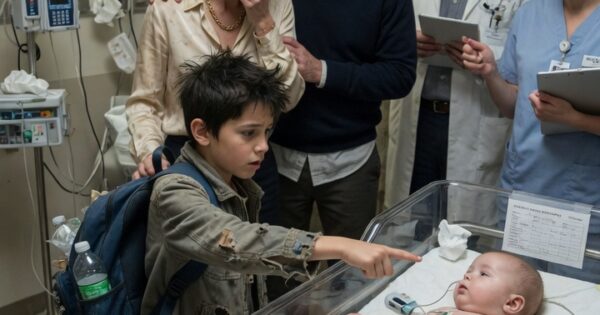


This Hospital Water Bottle begins with a barefoot child stepping into a private hospital suite where money, fear, and family reputation have already crowded around a dying man’s bed. The room belongs to Graham Holloway, a powerful CEO whose name is attached to bridges, contracts, and charity buildings, but the object that matters most is not expensive at all. It is a scratched plastic bottle with old tape around its middle, carried by a little girl who has no badge, no shoes, and no reason to be believed. What she says forces everyone in the room to look at the water beside Graham’s bed, the family member trying to control the room, and a warning that was buried for years.
Part 1
Ava Reed pushed the hospital door open with her shoulder because both her hands were wrapped around the old water bottle.
The guard near the wall moved fast.
“Miss, you can’t be in here.”
Ava didn’t step back. Her bare toes curled against the polished floor, leaving small damp marks from the rain outside. The bottle in her hands was scratched cloudy, the blue cap chewed at one edge, and the strip of masking tape around its middle had almost come loose.
“That water is why he’s in this bed,” she said.
The room went still around Graham Holloway’s hospital bed.
Dr. Miles Whitaker turned first. Margaret Holloway’s fingers tightened on the arm of her chair. Preston Holloway, Graham’s half-brother, gave the child one quick look, then looked past her at security.
“Remove her,” Preston said.
Ava lifted the bottle higher. “Please. My mom said if he got sick, I had to bring this to a doctor.”
The word mom made Margaret lean forward.
“What is your name?” the doctor asked.
“Ava Reed.”
Preston’s mouth moved before sound came out. “That family again.”
Ava heard the disgust in it. She had heard it from men in clean shoes before, when they came to the old cottage near the Holloway estate and told her mother to stop calling. Her mother would stand in the doorway with her work coat on, one hand hiding the same water bottle behind her hip.
Dr. Whitaker walked toward Ava slowly, as if a sudden movement might break whatever nerve had carried her there.
“Where did you get this water?”
“From the copper tap by the greenhouse,” Ava said. “The one they said was sealed.”
Preston laughed once. It was too sharp for the quiet room.
“There is no greenhouse tap in use,” he said. “This child is repeating nonsense from her mother.”
Ava’s face burned. She pressed the bottle against her chest. The plastic was cold from the rain, and the ridges dug into her fingers.
“My mom wasn’t lying.”
Graham’s eyelids twitched on the bed. Margaret saw it and reached for him, then stopped short, as if touch had become a question.
Dr. Whitaker held out one hand. “May I see it?”
Ava looked at Preston.
His eyes were flat now.
“Don’t hand that over,” he said.
That made the doctor look at him.
Margaret stood. “Preston.”
“It could be contaminated, planted, anything,” Preston said. “We have legal exposure all over this room already.”
Ava unscrewed the cap before anyone could take it. A sour metal smell rose from the bottle, faint but real, cutting through the flowers and disinfectant. Dr. Whitaker’s face tightened.
“Cap it,” he said gently.
Ava did.
The old bottle had lived under her mother’s kitchen sink for three years, wrapped in a dish towel beside a folded letter Ava had never been allowed to read. After her mother died that spring, Ava had taken both because they were the only things in the cottage that seemed to matter.
She had not known where to go until she saw Graham Holloway’s photograph on the hospital news outside a pharmacy window.
Now she pulled the letter from the pocket of her yellow dress. It was damp at the edges, creased into soft squares.
Preston crossed the room.
“That belongs to our legal department.”
Ava backed into the rolling tray beside the bed. The old bottle bumped against the metal rail with a hollow knock.
Margaret moved between them.
“Touch that child,” she said, “and I will have you escorted out.”
For the first time, Preston’s careful face slipped.
Dr. Whitaker took the letter. He read only the first few lines before he looked toward Graham’s IV stand, then the glass carafe on the bedside table. It was filled with clear water and floating lemon slices.
“Who brought that?” he asked.
Preston didn’t answer.
A senior assistant near the wall whispered, “Mr. Holloway’s personal supply. From home.”
Ava pointed at the carafe. “It smells the same.”
Dr. Whitaker called for a nurse, his voice low and urgent. The nurse took the carafe away with gloved hands. The room began moving all at once, but Ava could only watch the old bottle in her own grip, the one thing that had made adults angry enough to tell the truth by accident.
Margaret took the letter from the doctor.
Her lips trembled over one name at the bottom.
Erin Reed.
Ava’s mother.
Margaret looked at Ava, then at Graham, then back to the letter. “Why would Erin write to my son?”
Ava swallowed. “Because she said he would believe her.”
Preston turned toward the door.
The guard stepped in front of him.
Dr. Whitaker peeled the loose masking tape from Ava’s bottle to check the date beneath it. Something small fell out from under the tape and hit the floor.
A hospital bracelet.
Tiny. Pink. Folded flat.
Margaret picked it up with shaking fingers. On the faded band were two names.
Ava Reed.
Father: Graham Holloway.
Part 2
Margaret Holloway held the little bracelet as if it could cut her.
Ava watched her read it twice. Graham’s name looked strange on that pink hospital band, too big for something that had once fit around Ava’s newborn wrist. The old water bottle rested against Ava’s knees, cloudy and dented, while the nurse carried away the carafe Preston had not explained.
Preston did not shout.
That scared Ava more.
He straightened his jacket and said, “That bracelet is forged.”
Dr. Whitaker looked up from the letter. “Then you won’t mind waiting while we verify it.”
“I mind a child being used to attack this family while my brother is dying.”
Ava heard the word used and thought of her mother at the kitchen table, cutting coupons with one hand and rubbing the ache in her wrist with the other. Erin Reed had never used Ava for anything. She had hidden things until hiding them made her sick with worry.
Margaret sat down hard in the chair beside Graham.
“Read the letter out loud,” she said.
Preston’s head snapped toward her. “Mother.”
“Out loud.”
Dr. Whitaker read only what mattered.
Erin had been hired years earlier to test water lines at the Holloway estate after workers reopened an old greenhouse wing. She found unsafe levels in the copper line that fed the private guest cottage and, later, the main house service used for Graham’s personal water deliveries. She reported it. Graham asked for a second test. Before the second test came back, Erin was dismissed, barred from the property, and warned through company counsel not to contact him again.
Ava stared at Preston.
He stared at the floor.
Margaret’s voice came out thin. “Who signed the dismissal?”
No one moved.
Then the senior assistant, pale now, lifted her tablet. “Preston did.”
Preston turned on her. “Careful.”
She flinched, but kept the tablet raised. “The files are here. Sealed under estate maintenance.”
Dr. Whitaker had already ordered new tests on Graham’s blood and the bedside water. He spoke to the nurse in clipped phrases. Stop outside water. Notify toxicology. Preserve samples. Nothing dramatic. Just action. That made it worse for Preston because every calm instruction turned the room against him.
Ava picked up the old bottle and pressed her thumb against the place where the bracelet had been hidden. Her mother had put the truth under tape because paper could be taken, but nobody important looked twice at a child’s dirty bottle.
Margaret looked at Ava again.
“Did Graham know about you?”
Ava shook her head. “Mom said she tried to tell him. After I was born. Then the letters came back.”
Preston laughed under his breath. “This is absurd.”
Margaret stood and slapped him.
The sound was small, almost ordinary.
Preston touched his cheek, stunned less by pain than by the witnesses.
“You kept my son from his child,” Margaret said. “And you let him drink from a system you knew was unsafe.”
“I protected the company,” Preston said. His voice cracked at the edge. “One report would have destroyed contracts in three states. Graham was going to confess everything. Erin had him wrapped around her finger.”
Ava did not understand all of it, but she understood enough. Preston had not looked at Graham like a brother in that sentence. He had looked at the bed like it was an obstacle.
Graham made a rough sound.
Margaret turned so quickly the bracelet slipped from her palm. Ava caught it before it reached the floor.
Graham’s eyes were barely open. His lips moved.
“Ava?” he rasped.
No one spoke.
Ava walked to the bed because her mother had taught her that fear could stand beside you, but it did not get to choose your feet. She put the old water bottle on the table where Graham could see it, then placed the bracelet beside it.
“You didn’t know me,” she said.
Graham’s eyes wet over, but he did not reach for her. Maybe he knew he had no right to. Maybe his body was too weak. His fingers shifted once on the sheet.
“I looked,” he whispered. “He said you were gone.”
Preston sat down then, as if his legs had given up before his pride did.
The tests did not save Graham quickly. Nothing about it was clean. He stayed in the hospital for weeks, and the doctors never promised the old damage could be undone. Preston lost his seat, his trust access, and the family name he had guarded harder than any person. The company announced an independent investigation, then paid for water testing and medical care for families who had lived near old project sites.
It cost Margaret control. It cost Graham his public image. It cost Preston almost everything he thought made him untouchable.
Ava moved into Margaret’s guest room only after three visits, two lawyers, and one quiet afternoon when Graham apologized without asking her to make him feel better. She kept the old water bottle on the windowsill. Not because it was pretty. Because it had carried what adults refused to carry.
If a family protects its name by burying a warning, can an apology ever repay the people who paid the price?
Share this with someone who believes small voices still matter.