
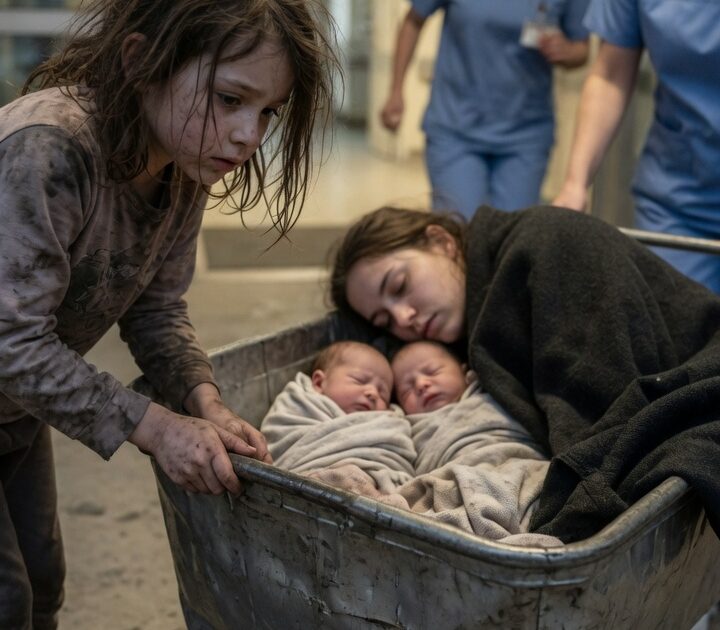

This Hospital Cart Secret begins at the emergency room doors, where a seven-year-old girl pushes an old metal cart carrying more than anyone inside the hospital is ready to face. On it are her unresponsive mother and newborn twin brothers, wrapped in whatever warmth she could find after three days without help. The story follows Elara through one terrifying morning, one bent cart wheel, and one document that exposes how badly adults failed a family already living too close to the edge. What starts as a rescue becomes a question about paperwork, fear, and who gets believed when the smallest voice in the room tells the truth first.
Part 1
The cart wheel slammed against the emergency room doorframe, and Elara shoved with both hands until the old metal frame scraped through.
The sound rang across the quiet entrance. She kept pushing anyway, her red fingers locked around the handle, her shoes leaving wet marks on the floor.
“My mom hasn’t woken up in three days,” she said.
The nurse with the charts stopped so fast the papers slid from her arms. Elara did not look at the papers. She looked at the cart, because her mother’s head had shifted under the thin coat, and the two bundles beside her had started making small, broken sounds.
“They’re cold,” Elara said. “I tried.”
Then the room moved.
A man in blue gloves lifted one newborn from the cart. Another nurse reached for the second. Someone rolled a bed beside Elara’s mother, speaking quick words that did not sound angry but still made Elara’s stomach tighten.
Elara held the cart handle.
The old cart had belonged to the apartment laundry room. Its wire basket was bent on one side, and one wheel squealed every few steps. She had pushed it down the hill, across two parking lots, and along the shoulder where cars blew dirty air into her face.
She had not let it tip once.
“What’s your name, sweetheart?” the nurse asked, kneeling in front of her.
“Elara.”
“How old are you?”
“Seven.”
The nurse’s eyes flicked toward the cart, then back to Elara’s hands. Dirt sat deep in the lines of her palms. A strip of cloth was wrapped around one thumb where the metal handle had rubbed the skin open.
“And the babies?”
“My brothers,” Elara said. “Owen and Silas.”
A doctor bent over her mother. “How long since she spoke?”
Elara counted the dark mornings in her head. The first one, when her mother had whispered for water. The second, when the twins cried until their voices got small. The third, when the room smelled sour and the phone on the counter had no bars.
“Three days,” she said. “Maybe a little more.”
The doctor’s face tightened, but his voice stayed low. “Did anyone help you?”
Elara pressed her knees against the cart so it would not roll away.
“Aunt Mara came,” she said. “She said Mom was tired from having them. She said hospitals take babies when people make trouble.”
The nurse’s hand paused near Elara’s sleeve.
“She told you that?”
Elara nodded. “She said if I called anyone, Owen and Silas would be split up. She took Mom’s purse.”
A woman at the desk reached for a phone. The doctor lifted Elara’s mother’s wrist and looked at the plastic band hidden under her sleeve.
“Wait,” he said.
The room thinned around Elara. Not quieter, not slower, just strange. Everyone still moved, but their eyes had gone to the band on her mother’s wrist.
The doctor read the tiny print. “She delivered here.”
Elara stared at him. “No. They were born at home.”
The nurse stood. “When?”
He turned the wrist toward the overhead light. “Three days ago.”
Elara’s fingers hurt around the cart handle. The old wheel squeaked under the pressure, the same sad sound it had made in the dark hallway when she loaded her mother onto it inch by inch.
Her mother had been here.
Here, where the lights were warm and people knew what to do.
A nurse opened the coat wrapped around Elara’s mother and found a folded discharge paper tucked into the lining. It had coffee stains at the edge and a hard crease down the middle. Elara knew that crease. Aunt Mara folded bills like that before slipping them into her pocket.
The doctor read the page once, then again.
“This says she refused further treatment,” he said.
Elara shook her head. “Mom couldn’t write. Her hand was shaking.”
The nurse looked at the bottom of the form. “There’s a signature.”
Elara leaned forward before anyone could stop her. The letters were big and sharp, with a curled M that looked like the one on the notes Aunt Mara taped to the fridge.
Then she saw the name written where her mother’s should have been.
Mara Vale.
The nurse whispered, “That isn’t the patient.”
Elara looked from the paper to her mother, then back to the cart that had carried all four of them to the only place left.
And from under the babies’ blanket, a second hospital band slipped free, printed with a name Elara had never heard: Mother listed as Mara Vale.
Part 2
The second hospital band lay against the blanket like a small plastic lie.
Elara stared at it until the letters blurred. Mara Vale. Not her mother’s name. Not the name Elara had written on school forms when the teacher asked who picked her up.
One twin fussed under the warmer. Elara stepped toward him, but a nurse touched her shoulder.
“He’s safe,” the nurse said.
Elara did not move back. “That tag is wrong.”
The doctor handed the band to another nurse. “Check delivery records. Now.”
A security guard came to the entrance, speaking quietly into his radio. The old cart sat beside the wall, empty except for Elara’s mother’s coat and the damp blanket she had used to wedge the babies in place. Without them on it, the cart looked smaller. Almost useless.
Elara hated that.
Her mother was wheeled behind a curtain. Elara tried to follow, but the nurse blocked her with a soft hand and a firm face.
“I need you right here.”
“I kept her on her side,” Elara said quickly. “I remembered from school. If people are sick, you put them on their side.”
“You did right.”
Elara looked at the curtain. “Then why is she still not waking up?”
The nurse did not answer fast enough.
A door opened near the desk. A woman in a tan coat hurried in, hair pinned too tightly, boots clicking hard on the floor. Aunt Mara’s eyes landed first on the empty cart, then on Elara.
“There you are,” Mara said.
Elara took one step back.
Mara smiled at the nurse, but her mouth barely moved. “I’m her aunt. This child ran off. Her mother has a condition. She gets dramatic.”
The nurse did not smile. “What is the mother’s full name?”
Mara’s eyes sharpened. “Where are the babies?”
Elara heard it. So did the doctor.
Not Where is my sister? Not Is she alive?
The doctor came around the desk with the discharge paper in his hand. “You signed this.”
Mara’s cheeks went pale under her makeup. “She asked me to.”
“She was losing blood,” he said. “She could barely stand.”
“She wanted to leave.”
Elara gripped the edge of the old cart. Its cold wire pressed into the cut on her thumb.
“No,” she said.
Every adult turned toward her.
Elara pointed at the coat in the cart. “Mom put that on the babies. Aunt Mara took it off them because she said it was hers. Mom tried to sit up. She said, ‘Don’t sign anything.’”
Mara’s face hardened. “Elara.”
The warning in her name was familiar. It had lived in their kitchen for months, tucked between unpaid bills and closed doors.
But the babies cried from the warmer, thin and angry, and Elara kept talking.
“She told Mom the hospital bill would make us lose the apartment. She said if Mom stayed, someone would ask questions about the money.”
A nurse at the computer spoke from behind them. “There’s a note in the file. Staff requested a social work consult. It was canceled after discharge.”
“By whom?” the doctor asked.
The nurse looked at Mara.
Mara lifted both hands. “I helped with paperwork. That’s all.”
A police officer entered then, quiet and plain-faced. No badge flashed in Elara’s eyes, no loud command. He only stood where Mara could see him and asked her to step aside.
Mara did not run. She looked at the babies instead, and for the first time Elara saw fear break through the neatness.
“I was going to sell the car,” Mara said. “Pay the rent. Fix it before anyone knew.”
“The car is gone,” Elara said.
Mara closed her mouth.
That was the first piece that made sense. The missing keys. The empty driveway. Her mother whispering, “Not the account,” before her words slipped away.
The doctor pulled the curtain back. Elara’s mother lay under clean blankets, tubes taped to her arm, lips cracked but moving.
“Elara,” she whispered.
The nurse lifted Elara onto a chair beside the bed. Elara reached for her mother’s hand. It was warmer than it had been on the cart.
“I brought them,” Elara said.
Her mother’s fingers twitched around hers. “I know.”
Mara was taken out before the twins left the warmer. She lost the apartment keys, the car money, and the right to stand in that room calling herself family. Elara lost something too: three nights of being the only grown-up in the house, and the idea that adults always told the truth when they sounded calm.
By evening, a social worker found a safe room in the hospital where Elara could sleep near her mother and brothers. The old cart stayed by the emergency doors until a janitor asked if anyone needed it.
Elara looked at its bent wire and bad wheel.
“Not anymore,” she said.
Before midnight, her mother woke long enough to touch each baby’s foot and then Elara’s bandaged thumb. No big promises came. No easy fix.
Only a quiet room, two sleeping newborns, and a child finally letting someone else hold the handle.
When a child tells the truth before any adult is ready to hear it, who should pay the highest price for ignoring her?
Share this with someone who would have listened to Elara the first time.


