
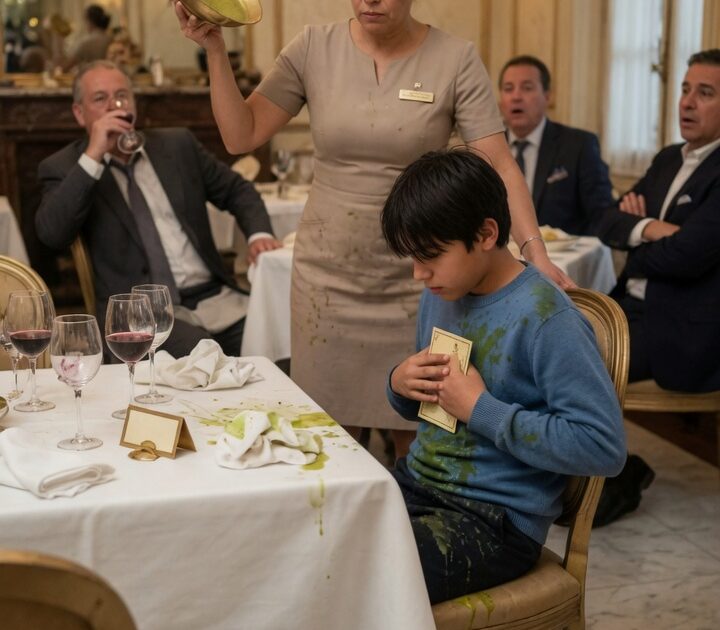

This Golden table boy begins with a teenage visitor holding an old card inside an elite dining room where every chair seems to know who belongs. Diego does not arrive with power, money, or a loud demand. He arrives with a promise his grandmother guarded for years, and the room judges him before anyone reads the card in his hands. What follows is not a simple story about wealth and manners. It is about who gets believed, who gets stepped around, and what happens when a forgotten promise is placed on the most expensive table in the room.
Golden table boy at the Reserved Table
Diego kept both hands around the thin gold table card while the waitress lifted a brass soup bowl above his blue sweater. He saw her shadow move across the white tablecloth before he saw her face. The card bent a little under his thumbs.
“Move,” she said.
He did not.
The dining room went narrow around him: cream-colored walls, polished floor, wineglasses catching warm light, men in dark jackets staring without turning their chairs. The table in front of Diego had a small brass plaque screwed into the edge. No menu. No plates. Just one empty place set with a folded napkin and a single water glass.
He had been told not to sit unless someone asked him.
So he stood beside the chair with the gold card in his hands.
The waitress, Carmen, looked him over as if dust had learned to walk. Her hair was pinned so tight it pulled at her temples. Her beige dress shone under the chandelier, clean and expensive-looking, the kind of uniform that made a person seem closer to the guests than to the kitchen.
“I said move,” she repeated. “This table is reserved.”
“I know,” Diego said.
His voice came out too small. He hated that.
A man at the next table lowered his fork. Another smiled into his wine. Diego felt the old heat rise behind his ears, the same heat he got when security guards followed him through stores because his shoes had cracked soles.
Carmen noticed the card.
Her hand came down fast.
Diego pulled it back against his chest. The motion made the bowl tilt. Thick green soup slid over the rim and slapped across his sweater, hot enough to make him stumble into the chair. The brass bowl hit the floor with a heavy sound.
No one moved at first.
A woman covered her mouth with two fingers. A businessman leaned away from the splash as if poverty could stain leather. Somewhere near the kitchen doors, a spoon dropped.
Carmen stood over Diego with the empty tray against her hip.
“Look what you did,” she said.
Diego pressed one sleeve to his chest. The soup smelled of cream and pepper. It ran down into his lap, soaking the folded paper inside his pocket. He did not check it. Not yet.
“I didn’t touch you,” he said.
“You were blocking service.”
“I was waiting.”
“For what?” Carmen looked at the table, then back at his shoes. “A handout?”
That got a small laugh from one corner of the room. It died quickly, but Diego heard it. He heard everything. The scrape of a chair. The piano player stopping mid-note. His own breathing, rough through his nose because he would not let it shake.
The old gold card at the founder’s table
He bent for the card.
Carmen stepped on one corner of it.
Not hard. Just enough.
Diego froze with his fingers inches from the floor.
“Boys like you do not come to this room,” she said, quieter now. The quiet made it worse. “Someone let you in by mistake.”
The card was old, not fancy in the way the restaurant was fancy. Its gold edge had worn thin. The letters on the front had faded from being held too often. Diego had carried it inside a plastic sandwich bag all morning, then taken it out at the host stand because his grandmother had told him a card like that should be shown with both hands.
He had promised her.
He looked up at Carmen.
“My grandmother cleaned the back hallway here for twenty-one years,” he said.
Carmen’s mouth tightened.
“Then she should have taught you which door to use.”
The room made a sound without becoming loud. A few guests looked down. One man in a silver watch checked his phone with great concentration. No one wanted the discomfort of choosing a side.
Diego wiped soup from the gold card with his sleeve.
A tall man in a black suit came from the private corridor near the bar. Alejandro Varela, the owner, moved quickly but not in panic. His face had gone flat, almost careful. Behind him came the host, pale and silent, carrying Diego’s small backpack by one strap.
Alejandro stopped at the edge of the spill.
“Who touched him?” he asked.
Carmen straightened. “Sir, I was handling it. He walked in off the street and tried to sit at the founder’s table.”
Diego’s fingers closed around the card. Founder’s table. That was what his grandmother had called it too, but never with a rich person’s pride. She had said it like a kitchen prayer.
Alejandro looked at Diego’s sweater, then at Carmen’s shoe still near the card.
“Pick your foot up,” he said.
Carmen blinked. “Mr. Varela?”
“Now.”
She moved.
Diego reached for the card, but Alejandro bent first. He lifted it with both hands, the way Diego had been told to do. Then he turned it over.
The room leaned toward him without meaning to.
Alejandro’s face changed at the back of the card. Not fear. Not kindness. Recognition, sharp enough to cut through every table.
He read the typed line under the gold seal.
Then he looked at Diego and said, “Forgive us, Mr. Reyes.”
Carmen laughed once, thin and wrong. “That’s not possible.”
Alejandro held the card up where everyone could see.
The card had Diego’s name typed under the gold seal.
The Card That Made the Room Go Quiet
Diego’s hands stayed closed even after Alejandro spoke his name. Soup dripped from his sleeve onto the marble in slow, pale drops. He looked at the card, then at the owner, then at the chair no one had allowed him to touch.
Carmen’s face lost its color in pieces.
“No,” she said. “There has to be another Diego Reyes.”
Alejandro did not answer her. He took a clean napkin from the golden table and held it out to the boy.
Diego stared at it.
It was folded into a sharp white shape, too clean for his hands. He took it anyway and pressed it to the card first, not his sweater.
That was the first thing the room noticed.
Alejandro turned to the host. “Bring the envelope from the safe.”
The host did not ask which one.
Carmen stepped back. Her heel found the spilled soup and slid half an inch. One of the diners reached toward her, then stopped before touching her arm.
“Sir,” she said, lower now, “I didn’t know.”
Diego looked at her. He had heard that sentence before. Teachers said it when they found out his grandmother had died during exam week. A landlord said it when he realized the rent money had been in a pharmacy envelope. People used it when they wanted the damage to become an accident.
Alejandro pulled out the chair at the golden table.
“Please sit.”
Diego did not move.
“My grandmother said I should stand until Mr. Varela came,” he said.
Alejandro’s jaw tightened at the old name. The founder had been his father, dead for nine months, praised in newspapers and toasted in this same dining room by people who had never seen the staff stairwell.
The host returned with a flat brown envelope sealed in plastic. No decoration. No ribbon. Just a date in black ink.
Alejandro opened it with a table knife.
Inside were three things: a photograph, a handwritten note, and a service contract with a red circle around one paragraph. Alejandro placed them on the table one at a time.
Diego saw his grandmother younger in the photograph, standing near the kitchen door in a gray uniform. Beside her stood Arturo Varela, the founder, one hand on the golden table, the other holding the same card.
Carmen looked at the picture and swallowed.
“She worked nights,” Diego said.
Alejandro nodded. “She also saved my father’s life.”
The room stayed still.
Not dramatic. Worse than that. Practical.
Alejandro slid the note toward Diego but did not read it aloud. Diego already knew the first line because his grandmother had made him practice it: If my son forgets, show him the card.
The second piece came from the contract. Arturo had signed a promise years earlier, after collapsing in the service corridor during a private dinner. Rosa Reyes found him. She called the ambulance. She stayed with him when his own guests thought he had gone to make a phone call.
In return, Arturo had written that one seat at the founder’s table would remain available every year to Rosa Reyes or her family, and that a scholarship fund in her name would be administered through the restaurant profits.
The fund had never been opened.
Alejandro did not lift his eyes from the paper.
“My office filed it as ceremonial,” he said.
Diego’s mouth twisted. “Ceremonial doesn’t pay tuition.”
A small sound came from one table. Someone had been holding a breath too long.
Carmen gripped the back of a chair. “I only saw a boy walking in like he owned the place.”
Diego looked down at his sweater. The stain had spread across the blue fabric. He thought of his grandmother ironing that sweater with a towel over it so the old cotton would not shine.
“I didn’t want to own it,” he said. “I wanted you to read it.”
Alejandro folded the contract closed.
Then he did something no one expected. He took off his suit jacket and placed it over the back of Diego’s chair, covering the soup mark on the upholstery before anyone could complain. It was a small thing. It cost him nothing and still cost him his face in front of the room.
“Carmen,” he said, “you will finish your shift in the kitchen washing station. After that, you will meet with human resources and with me.”
Her lips parted. “After twenty years?”
“Especially after twenty years.”
Diego watched her.
He had imagined, on the bus there, that someone might apologize. He had not imagined what an apology looked like when it had to walk past people with champagne and expensive watches.
Carmen removed her name pin and set it on the table. Her hands were not steady.
“I’m sorry,” she said.
It was too late and not enough. It was also the first time she had looked at his face.
Diego did not forgive her. He did not punish her either.
He picked up the photograph and tucked it into the dry side of his backpack.
“My grandmother said the seat wasn’t for revenge,” he said.
Alejandro looked at him.
“She said if rich people had to eat beside the people they stepped around, maybe they’d chew slower.”
No one laughed.
Diego finally sat.
The chair was wider than he expected. Too polished. Uncomfortable in a way he could not explain. Alejandro sat across from him and signed the first scholarship form on the table, in front of every guest, with a borrowed pen that skipped twice before the ink caught.
Carmen walked toward the kitchen, carrying the empty brass bowl.
At the doorway, Diego spoke again.
“Don’t make her wash alone.”
Carmen turned.
Diego did not look away. “Make everyone who laughed help for one hour.”
Alejandro followed the boy’s eyes across the room. Silver watch. Wineglass. Covered mouths. The people who had done nothing became busy with their napkins.
“That can be arranged,” Alejandro said.
By closing time, six guests had left angry, two had written checks to the Rosa Reyes fund, and Carmen had scrubbed cream from the floor beside a lawyer who kept apologizing to the mop.
Diego went home in Alejandro’s jacket because his sweater still smelled of pepper and shame. He never returned the jacket. Alejandro never asked.
Months later, the golden table had a new card under the brass plaque. It did not name donors. It named Rosa Reyes, night cleaner, witness, and the reason the seat stayed open.
Was Diego right to ask for dignity instead of revenge, or should public cruelty always cost more?
Share this with someone who understands why one seat at a table can matter.


