
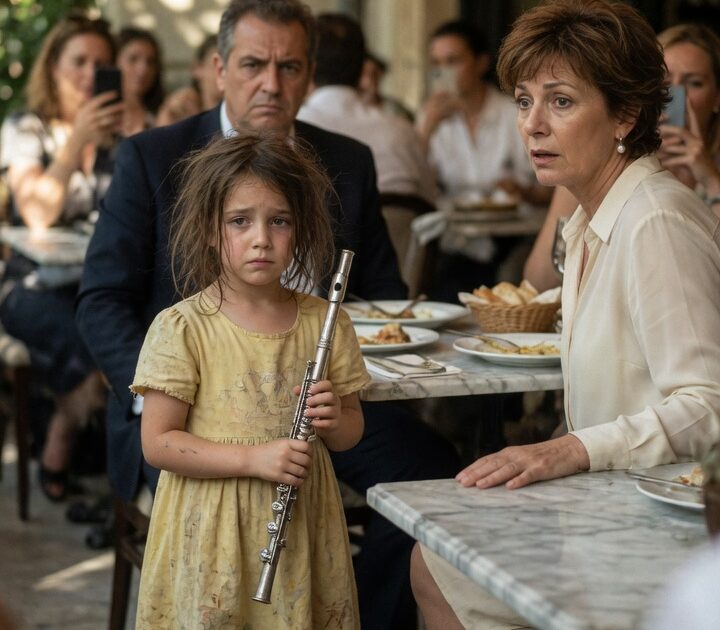

This Flute Girl Secret begins on the terrace of a luxury restaurant, where a hungry five-year-old girl asks strangers for food and is mocked into performing for them. What starts as a cruel public moment becomes something far more personal when one woman recognizes the small silver flute in the child’s hands. The melody is not a street tune. It belongs to a lost sister, a broken promise, and years of money that never reached the person it was meant to save. At the center of the story is one dented instrument, a child brave enough to play it, and a family forced to answer for what silence protected.
Part 1
“Please, I just need money for food. Please.”
The child’s voice cut across the terrace before the waiter could reach her. Forks hovered over white plates. A woman in pearls turned with her mouth still half open. A glass of sparkling water trembled in someone’s hand.
The little girl stood beside the best table in the restaurant, small enough that the marble edge came almost to her shoulder. Her dress was clean once, maybe yellow, but the hem was gray from the street. One bare foot pressed over the other as if she could hide them. In both hands she held a small silver flute with a dent near the mouthpiece.
Evelyn Hart looked up from her untouched salad.
She had come to the restaurant because her husband, Richard, insisted the board needed to see her smiling in public again. Hart & Vale had opened its new terrace that week, all white umbrellas, brass lamps, and people who knew how to pretend not to stare.
But everyone stared now.
Richard leaned back in his chair. His cufflinks flashed in the afternoon sun.
“If you want money,” he said, smiling without warmth, “impress us.”
A few guests laughed. Not loudly. Just enough to make it worse.
The child’s fingers tightened around the flute. Evelyn saw dirt under her nails, a raw place at one knuckle, the careful way she kept her chin up. Pride, thin as paper, but still there.
“That’s enough,” Evelyn said.
Richard did not look at her. “It’s lunch entertainment.”
Phones lifted from tables.
The girl glanced toward the gate. For a second, Evelyn thought she would run. Then the child raised the flute. Her wrists shook so badly the silver caught the light in little broken flashes.
The first note came out weak.
Someone snorted.
Then the second note found its place.
Evelyn’s hand closed around the cloth napkin in her lap.
The melody was old. Too old for that terrace, too old for the polished plates and imported flowers. It stepped carefully through the air, soft and plain, the way a child might hum to herself in a dark room. Evelyn had not heard it in twenty-three years.
Anna had written it on the back stairs of their father’s house with a cheap school flute across her knees. Anna, who used to tap rhythms on window glass. Anna, who laughed with one front tooth slightly crooked. Anna, who vanished after a fight the family never named out loud.
Evelyn stared at the dented flute.
There was a tiny scratch near the bottom joint.
No.
She pushed her chair back. The legs scraped the stone.
Richard’s smile thinned. “Evelyn.”
The girl kept playing. Her eyes shone, but she did not wipe them. The music rose over the terrace, not grand, not perfect, but steady enough to make the room inside the restaurant go quiet too. A busboy stopped with a tray against his hip. The head waiter lowered his hand.
Evelyn remembered a birthday ribbon. Anna holding the same flute in both hands. Evelyn, sixteen and dramatic, saying, “When you get famous, you owe me front-row seats.”
Anna had rolled her eyes and played the little stairwell song until their father shouted for silence.
The melody ended on a note so soft it barely survived the wind.
For a moment, no one clapped.
Then Richard lifted one hand.
“Well,” he said, “that was touching.”
The child lowered the flute. Her shoulders stayed stiff, as if she expected someone to grab it from her.
Evelyn stepped around the table. “Where did you learn that song?”
“My mom,” the girl said.
Her voice had gone small. The bravery had cost her something.
“What’s your name?”
“Maisie.”
“How old are you, Maisie?”
“Five.”
Evelyn crouched, careful not to crowd her. The stone was hot through her skirt. Up close, she saw the child had a ribbon tied around the flute case, blue once, now faded almost white.
“Your mother taught you?”
Maisie nodded.
Richard stood. “Evelyn, don’t make a scene.”
That made Evelyn look at him. His face was still arranged for the guests, but his eyes were sharp now. Warning her. Measuring what she had noticed.
A strange coldness moved through her.
For years, Richard had handled the private accounts. For years, Evelyn had sent money to a woman she was told refused to answer. For years, every envelope came back through Richard’s office with the same neat explanation.
No forwarding address.
No contact requested.
Leave it alone.
Evelyn turned back to the girl. “What is your mother’s name?”
Maisie looked from Evelyn to Richard, then down at the flute.
“She said not to tell rich people,” she whispered.
The terrace shifted. Chairs creaked. A phone clicked.
Evelyn held out her empty hands. “You can tell me.”
Maisie swallowed. She slid one hand into the torn pocket of her dress and pulled out a folded photograph, soft from being handled too often. She opened it with care.
A young woman sat on a back staircase, a silver flute across her lap, smiling at someone outside the frame.
Anna.
Evelyn reached for the marble table to steady herself.
Maisie pointed at the woman in the picture.
“My mom’s Anna Hart,” she said. “She told me if I ever got hungry enough, I should play this song and find Aunt Evelyn.”
Part 2
Maisie’s small finger stayed on the photograph as the whole terrace listened.
Evelyn did not reach for the picture right away. She was afraid that if she touched it, the paper would prove real. Anna’s smile. The back stairs. The flute Evelyn had bought with babysitting money and hidden from their father until the cake came out.
Richard moved first.
“Give that to me,” he said.
Maisie pulled the photograph to her chest.
Evelyn stood between them. “Don’t.”
His face changed just enough. Not anger. Calculation.
“Evelyn, this child is confused.”
“Then why do you want the photograph?”
No one laughed now. A waiter set down a pitcher and missed the edge of the side table. Water ran over the stone and dripped onto the terrace floor.
Maisie looked at the puddle, then at the bread basket on Evelyn’s table.
The sight of it settled Evelyn. A hungry child was still a hungry child, no matter what name she carried.
She took the basket and knelt again. “Eat slowly.”
Maisie grabbed one roll, then stopped, ashamed of how fast her hand had moved.
“It’s yours,” Evelyn said.
The girl bit into it and closed her eyes for one second.
Richard lowered his voice. “This is not the place.”
“It is now.”
Evelyn turned to the head waiter. “Call Dr. Bell. Tell him a woman named Anna Hart may need medical help. And bring my car around.”
Maisie shook her head hard. “Mom said no hospital bills. We can’t.”
“I’ll pay.”
“She said you already did.”
The words landed harder than the glass that had broken earlier.
Evelyn looked at Richard.
He adjusted his cuff, the old tell he had when a question came too close. “You don’t know what she means.”
Maisie opened the flute case. Under the blue ribbon was a stack of envelope corners, each torn clean from a larger letter. Evelyn recognized her own handwriting on one.
Anna, please call me.
Another read, I sent enough for rent and medicine.
A third had a bank stamp across it.
Evelyn’s mouth went dry. “Where did you get these?”
“Mom saved them from the trash behind an office,” Maisie said. “She said the money never came.”
Richard reached for his phone. “I’m calling our lawyer.”
Evelyn took the phone from his hand and placed it on the table.
Guests watched openly now. Not for entertainment. For the answer.
“Your office handled those transfers,” Evelyn said.
Richard’s jaw worked once. “I protected you.”
“From my sister?”
“From her demands.”
Maisie flinched at his tone. Evelyn saw it and hated that she had ever let this man speak for her.
“Where is Anna?” she asked.
Maisie pointed beyond the terrace gate. “At the church steps. She told me to come back if nobody helped.”
Evelyn did not wait for permission. She lifted Maisie into her arms. The child was lighter than she should have been, all elbows and heat and the flute case pressed between them.
Behind her, Richard said, “If you walk out like this, the board will hear everything.”
Evelyn stopped.
The restaurant had gone quiet enough that the kitchen bell sounded rude.
She looked back at the table where the investors sat, where her mother’s old friends stared into their wine, where Richard stood with his perfect suit and his ruined smile.
“They should,” she said.
Anna was sitting on the church steps two blocks away, wrapped in a thin cardigan under the hard afternoon light. Her face was older, narrower, but when Maisie called “Mom,” Anna lifted her head with the same crooked tooth showing through fear.
Evelyn set Maisie down.
The little girl ran to her mother, flute case bumping against her side.
Anna tried to stand and failed. Evelyn caught her under the arms. For a few seconds neither sister spoke. Anna smelled of rain, medicine, and the cheap soap from public restrooms.
“I wrote,” Evelyn said.
“I know now,” Anna whispered. “I found pieces.”
The ambulance came. So did Richard’s lawyer. So did the board chairman, pale and furious, asking Evelyn to keep family matters private until Monday.
Evelyn signed the hospital guarantee anyway. Then she signed a statement for the accountant. By night, Richard was removed from the restaurant group’s financial accounts. By morning, Evelyn resigned from the family board before they could demand silence in exchange for sympathy.
It cost her the marriage first. Then the chair. Then the easy respect of people who preferred betrayal when it stayed quiet.
Anna spent three weeks in a hospital bed while Maisie slept in a chair beside her, one hand always near the flute case. Evelyn came every morning with breakfast and no speeches. Some days Anna spoke. Some days she only looked out the window while Evelyn sat there and took what silence she had earned.
On the day Anna was discharged, Maisie played the stairwell song in the hospital courtyard. This time no one laughed. Evelyn stood beside Anna, holding the old photograph flat against her coat.
Anna touched the dent in the flute.
“You kept it,” Evelyn said.
Anna looked at Maisie. “It kept us.”
Evelyn had money enough to fix many things, but not the years. Not the missed birthdays. Not the nights Anna thought her sister had chosen comfort over her.
She could only stay, pay what was owed, and stop letting polite rooms decide who mattered.
If helping someone late is still helping, how much forgiveness can anyone fairly ask for?
Share this with someone who believes quiet wrongs still need an answer.