
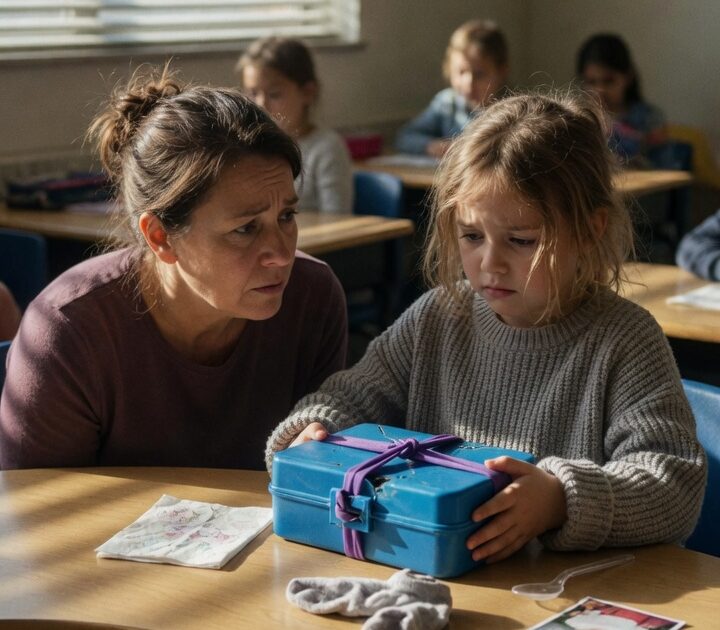

This Classroom Secret begins with a cracked blue lunchbox, a quiet first-grade girl, and a teacher who notices that silence can carry more than shyness. In Room 14, Ivy Callahan has spent months trying not to be seen, keeping her sleeves low and her lunchbox close. When the box falls open in front of the class, it reveals more than forgotten school things. It shows a child trying to protect someone younger, a teacher forced to choose quickly, and a truth that had been hiding in plain sight behind ordinary school routines.
Part 1
The blue lunchbox slid off Ivy Callahan’s lap and hit the classroom floor with a hollow crack.
Every child in Room 14 turned.
Naomi Whitaker looked up from the attendance sheet, pencil still between her fingers. Twenty-two first-graders had been rustling worksheets, whispering over crayons, and dragging chair legs against the tile. Then the sound of that lunchbox landed in the room, and every small noise seemed to fold itself away.
Ivy sat at the horseshoe table near the reading shelf, both hands clamped around the sleeve of her oversized gray sweater.
“Leave it,” she whispered.
No one moved.
Naomi set the attendance sheet down and crossed the room slowly. Ivy had been in her class since September, a small child with sandy brown hair, worn sneakers, and a way of watching doorways before she watched people. She never complained. She never raised her hand unless Naomi called her name first.
The blue lunchbox had come with her every day.
It was scuffed along one side, with a broken plastic latch that Ivy held shut using a purple hair tie. Most mornings, Ivy kept it pressed against her stomach until snack time. She ate fast, then tucked away whatever was left.
Naomi had noticed.
Teachers noticed what children thought they hid.
“Ivy,” Naomi said, crouching beside her chair, “did it break?”
Ivy shook her head hard. Her eyes stayed on the lunchbox.
A few crayons had rolled beneath the table. A folded paper napkin had slipped out. So had a tiny pair of socks, gray at the heels, and a plastic spoon wrapped in tissue.
One boy whispered, “Why does she have socks in there?”
Ivy’s face went white.
Naomi turned to the class. “Everyone, open your reading folders. Eyes on your own page.”
Chairs scraped. Pages flipped. But the room still listened.
Naomi reached for the lunchbox.
Ivy grabbed her wrist.
The grip was quick and desperate, too strong for such a small hand.
“Please don’t tell anybody,” Ivy said.
Naomi froze.
The words were not loud, but they carried something that made Naomi’s skin go cold. Not fear of a broken rule. Not shame over a messy lunchbox. Something practiced.
She lowered her voice. “Tell anybody what?”
Ivy’s lower lip trembled once. She pulled her sweater sleeve down farther, covering her hand until only her fingertips showed.
Naomi noticed the motion.
“Ivy, sweetheart, did someone tell you not to talk?”
The child stared at the blue lunchbox as if it could answer for her.
At the front of the room, the classroom phone rang.
Everyone jumped.
Naomi stood, but Ivy’s hand stayed locked around her wrist.
“Don’t answer,” Ivy whispered.
Naomi looked from the phone to the child’s face.
The phone rang again.
Room 14 had rules. A ringing classroom phone usually meant the office, a parent, a schedule change, a child going home early. Naomi had answered hundreds of calls without thinking.
This time, she let it ring.
“I’ll call back,” she said.
Ivy closed her eyes for half a second.
Naomi gently peeled the child’s fingers from her wrist. That was when Ivy’s sleeve shifted.
Just enough.
Beneath the stretched cuff, Naomi saw a narrow strip of medical tape wrapped around Ivy’s forearm. It was dirty at the edges, not fresh, and under it the skin looked swollen.
Naomi kept her face still.
“Ivy,” she said, “did you hurt your arm?”
The child yanked the sleeve down.
“No.”
The answer came too fast.
Naomi glanced at the lunchbox again. The purple hair tie around the latch had snapped loose. Something else had slid halfway out from the inner pocket: a school photograph, bent across the middle.
Naomi recognized Ivy in the picture from class picture day.
But there was another child beside her.
A younger boy with the same sandy hair, sitting on a kitchen chair, holding the same blue lunchbox in both hands.
Naomi had never heard Ivy mention a brother.
She picked up the photo.
Ivy’s chair legs screeched as she stood.
“No,” Ivy said. “That’s not for school.”
Naomi turned the photo over.
On the back, written in uneven pencil, were five words.
Milo ate yesterday. My turn.
Naomi felt the room tilt around the edges.
The phone at the front rang again.
This time, the office intercom clicked on before Naomi could reach it.
“Room 14, Mrs. Whitaker? Ivy Callahan’s aunt is here to pick her up. Please send her down with her lunchbox.”
Ivy looked at Naomi.
Then the child slowly opened the lunchbox all the way.
Inside, under the napkin and socks, was a folded note written on the back of a spelling worksheet.
Naomi read the first line.
If I go home today, Milo won’t wake up.
Part 2
Naomi kept the note flat against her palm while Ivy watched the classroom door.
The intercom clicked again.
“Mrs. Whitaker, please send Ivy now.”
Naomi did not move toward the door. She looked at Ivy’s small face, then at the blue lunchbox open on the table. Socks. Spoon. Bent photo. A note that had taken more nerve to write than most adults ever needed.
“Where is Milo?” Naomi asked.
Ivy pressed both hands over the lunchbox.
“At home.”
“Is he sick?”
Ivy nodded once.
“Is there an adult with him?”
The child’s mouth opened, but no sound came.
Naomi stood and walked to her desk. She kept her body between Ivy and the classroom door as she picked up the phone and dialed the office.
“Do not send anyone to this room,” she said quietly. “Call the principal. Call the nurse. And call the school resource officer now.”
There was a pause.
“Naomi, her aunt is upset.”
“Then keep her in the office.”
Naomi hung up before questions could follow.
Ivy stared at her as if she had done something dangerous.
“She’ll be mad,” Ivy said.
“At me?”
“At both.”
Naomi knelt again. “What happened to your arm?”
Ivy slid the sleeve back only an inch. The tape showed. Beneath it, the skin was puffy and badly cared for.
“Milo fell,” Ivy whispered.
Naomi waited.
“I tried to catch him. Aunt Lorna said if I told, they’d split us up.”
A chair scraped across the room. One of the children had stood with a reading folder clutched to his chest.
Naomi looked at the class. “Mrs. Bell is coming. You’re going to the library with her.”
Within minutes, the neighboring teacher appeared at the door. Naomi handed over the class with a calm face she did not feel. Ivy stayed behind, sitting beside the blue lunchbox with her fingers hooked through the handle.
When the room emptied, the nurse came in with Principal Harris.
Ivy pulled the lunchbox closer.
“No hospital,” she said.
The nurse softened. “We’re just going to look.”
Ivy shook her head. “If you take me, she’ll move him.”
That was the first partial truth.
Milo was not only sick.
He was being hidden.
The school resource officer arrived, then stepped outside to call child protective services and local police. Naomi stayed with Ivy, asking only small questions.
Apartment number.
Street name.
Was the door locked.
Could Milo stand.
Each answer came out like a pebble dropped into a cup.
By the time officers reached the duplex on Marigold Lane, Ivy was sitting in the nurse’s office with a cup of water she did not drink. Her blue lunchbox sat on her knees.
At 10:42, Naomi’s phone buzzed.
Principal Harris read the message first. His face tightened.
“They found him.”
Ivy’s fingers dug into the plastic handle.
“He’s alive,” he said quickly.
The child folded forward over the lunchbox without crying. Her shoulders shook once, then went still.
Milo was five, feverish, and locked in a back bedroom with a blanket and half a cup of water. The apartment had food in a cabinet too high for children to reach. Aunt Lorna had been collecting support checks for both children since their mother’s death, while telling neighbors the boy lived with relatives out of state.
The full picture came later, piece by piece.
The oversized sweaters hid Ivy’s arm.
The lunchbox carried food to Milo.
The socks were for his cold feet.
The spoon was because he was too weak to hold the fork Aunt Lorna left by the sink.
Ivy had not been quiet because she had nothing to say.
She had been quiet because every word had a cost.
That afternoon, Aunt Lorna was not allowed back past the office doors. The checks stopped. The apartment was sealed. Ivy and Milo were taken together to emergency foster care with a retired librarian who lived three blocks from the school and knew how to make soup without asking too many questions.
Naomi paid a cost too.
She sat through interviews, reports, and angry calls from adults who wanted to know why she had waited, why she had not seen enough sooner, why a child had needed a lunchbox to speak.
She had no neat answer.
Weeks later, Ivy returned to Room 14 for half days. Milo came with the foster mother once, wrapped in a green coat, holding the blue lunchbox by its purple hair tie repair.
Ivy let him carry it.
Naomi watched from the classroom doorway as the two children walked down the hall side by side.
The lunchbox was still cracked.
But it was empty now.
And for the first time, Ivy did not hold it like a secret.
When a child protects someone with silence, how much should the world blame the silence, and how much should it blame the people who made speaking feel unsafe?
Share this gently for the quiet children someone needs to notice.


