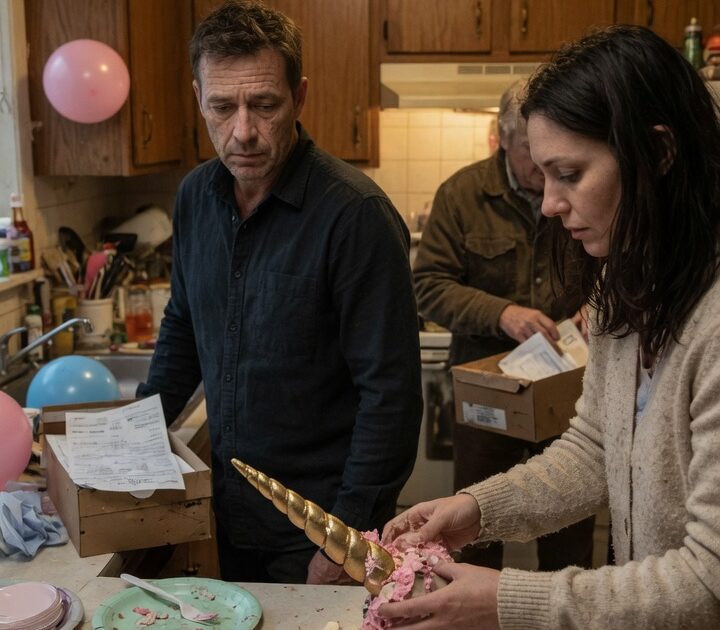

This birthday cake secret begins with a little girl’s ruined wish, a broken unicorn horn, and a family room full of adults who had to decide whether silence was easier than truth. Emily’s sixth birthday was supposed to be small, bright, and ordinary, the kind of party where children remember frosting and balloons instead of shame. But when her cousin destroyed the cake and his mother laughed, one stained bakery receipt became more than proof of a ruined dessert. It became the object everyone kept looking at while an older family lie pushed its way into the open.
Part 1
Logan Reed slammed both hands into the unicorn cake before Emily had finished smiling at the candles.
Pink frosting jumped across the paper plates. The gold horn snapped sideways and rolled under the table. Six small voices went quiet at once, as if the birthday song had been cut with scissors.
Daniel Carter reached for his nephew, but Logan had already lifted the cake board and tipped the whole ruined thing against his shirt.
“Logan, stop,” Daniel said.
His sister Rebecca laughed from the sofa.
“Oh, don’t be so dramatic,” she said, waving her phone in the air. “It’s only cake.”
Emily stood frozen in her silver birthday crown. Her little hands were still clasped for the wish she had not made. On the table, beside the smashed frosting, sat the bakery receipt Daniel had tucked under a napkin that morning after paying extra for the tiny sugar stars Emily had begged for.
The receipt was silly, ordinary paper. But Daniel remembered Emily holding it in the car like a ticket to something important.
“She picked the horn herself,” he said, keeping his voice low.
Logan looked at him with frosting on his fingers and a grin that did not belong on an eight-year-old’s face.
“Then she can eat it where trash goes,” Logan said.
Before Daniel could catch him, Logan dragged the ruined cake board toward the hallway. Several children followed because children followed noise before they understood shame. Emily did not move until Rebecca stood and called out, still laughing, “Careful, Logan, don’t get it on my shoes.”
Daniel’s wife, Mara, grabbed Emily’s shoulders. “Stay with me, sweetheart.”
But Emily pulled away.
In the downstairs bathroom, Logan had set the collapsed cake beside the closed toilet lid. Pink frosting smeared the tile. The unicorn horn lay cracked near the bath mat.
“Eat it from there,” Logan said.
Emily stared at the cake, then at the little gold horn. Her face did not crumple. That hurt Daniel more. She simply reached down, picked up the broken horn, and held it in her fist.
Daniel stepped between them.
“Party’s over,” he said.
Rebecca’s laugh thinned. “You’re throwing us out because kids played rough?”
“No,” Daniel said. “Because your son humiliated my daughter and you enjoyed it.”
Rebecca’s eyes shifted toward the doorway, where several parents had gathered in stiff silence. Her cheeks went red, but not from guilt. From being seen.
She grabbed Logan’s wrist. “Come on. Your uncle always has to perform.”
Logan yanked back. “Mom said Emily gets everything because Uncle Dan feels bad.”
The hallway went colder than the bathroom tile.
Daniel looked at Rebecca. “What does that mean?”
Rebecca’s mouth tightened. “Nothing. He repeats nonsense.”
But Logan was still angry, still sticky with frosting, still too young to know which adult secrets were supposed to stay locked.
“She said Emily isn’t special,” he muttered. “She said I should have had this house.”
Mara picked up the cake receipt from the hallway floor. It had stuck to someone’s shoe, leaving a pink thumbprint over the bakery name.
Daniel saw her fingers tremble.
His parents arrived twenty minutes later, after Rebecca had left with Logan and after every guest had been quietly collected. Emily sat upstairs in her pajamas, holding the broken sugar horn while Mara wiped frosting from the baseboards.
Daniel’s mother came through the door without taking off her coat.
“Where’s Rebecca?” she asked.
“Gone,” Daniel said.
His father would not look at him. He stood near the kitchen island, rubbing one thumb over the other, a nervous habit Daniel had known since childhood.
“Your sister called us,” his mother said. “She’s upset.”
Daniel placed the stained bakery receipt on the counter.
“Emily is six,” he said. “Her cousin told her to eat her birthday cake beside a toilet. Rebecca laughed.”
His mother flinched at the word toilet, but his father looked at the receipt.
Then he looked away.
That was when Daniel noticed the old shoebox in his father’s hands. Brown cardboard. White string. The kind of box families used for photos they did not want in albums.
“Dad,” Daniel said. “What is that?”
His father swallowed.
“Rebecca asked us never to bring this here.”
His mother snapped, “Alan.”
“No,” Alan said, and his voice cracked on the single word.
He set the box beside the ruined receipt. Inside were hospital papers, an old photo of Rebecca at nineteen, and a folded paternity form with Daniel’s name on the witness line. He remembered signing something after his brother Mark’s car accident, remembered grief, stale coffee, Rebecca crying into his jacket.
But the father’s name printed on Logan’s birth record was not Mark Reed.
It was Alan Carter.
Daniel looked from the paper to his father’s gray face.
Then Mara came down the stairs carrying Emily’s broken unicorn horn, and Alan whispered, “Logan is my son.”
Part 2
Mara stopped on the last stair with the broken unicorn horn in her palm.
Daniel did not move. The kitchen light buzzed above the island. His father’s words sat between them, too plain to misunderstand and too ugly to touch.
“Logan is my son,” Alan said again, softer.
Daniel’s mother slapped her hand on the counter. “You had no right.”
Alan looked at the box, not at her. “I lost that right years ago.”
Mara came forward and placed Emily’s broken horn beside the bakery receipt. Sugar dust clung to her fingers. She had cleaned the bathroom floor, changed Emily’s pajamas, and tucked six birthday cards under a pillow because Emily had not wanted to open them anymore.
Daniel pointed at the paternity form.
“Why was my name on this?”
“You signed witness papers at the hospital,” Alan said. “Mark had just died. Rebecca was pregnant and scared. Your mother said people would destroy her if they knew.”
“People?” Daniel asked.
His mother’s mouth folded. “Family. Church. Neighbors. Everyone.”
“So you let Mark’s name cover it.”
Alan nodded once.
Daniel reached into the box. Beneath the form was a bank envelope with Rebecca’s name on it. Inside were copies of checks, monthly amounts, each one signed by Alan. Some were recent.
Mara picked up one check and turned it toward Daniel.
“That’s more than our mortgage,” she said.
His mother stepped closer. “Rebecca needed help.”
“Emily needed a birthday,” Mara said.
No one answered.
The front door opened without a knock. Rebecca came in with Logan behind her, his hair wet from a rushed wash, his collar still stained pink. She froze when she saw the box.
“You brought that here?” she said.
Alan did not defend himself.
Daniel watched Logan. The boy’s grin was gone. He stared at the cake receipt and the broken horn like he had walked back into a room where the game had ended without him.
Rebecca grabbed the paternity paper, but Mara placed her hand over it.
“Don’t,” Mara said.
Rebecca’s face hardened. “This is private.”
“You made Emily’s humiliation public,” Daniel said.
Rebecca looked toward the stairs. For the first time that day, her voice lowered.
“Logan hears things. He was angry.”
“He said he should have had this house.”
Alan closed his eyes.
Rebecca’s chin lifted. “Because Dad promised he’d take care of us. Then you got the house, the holidays, the clean little family. I got whispers and envelopes.”
Daniel stared at her.
“This house came from Mara’s mother,” he said.
Rebecca blinked.
Mara’s voice was quiet. “You knew that.”
Rebecca did not answer.
Logan shifted behind her. “Mom?”
She turned too fast. “Go wait in the car.”
“No,” Alan said.
It was the first sharp sound he had made.
Logan looked at him then, really looked. Same uneven left eyebrow. Same habit of pressing thumb to thumb. Daniel saw it and hated that he had missed it.
Alan crouched, moving slowly because his knees were bad.
“I should have told the truth,” he said to Logan. “Not like this. Not after you hurt Emily. But I should have told you.”
Rebecca whispered, “Alan, stop.”
Logan’s eyes flicked to his mother. “Is he my dad?”
Rebecca’s hand tightened around her purse strap until the leather creaked.
“Yes,” she said.
The word cost the room its last hiding place.
Logan stepped back, bumping the wall. He wiped one hand over his mouth, though there was no frosting left there.
“You said Uncle Mark was.”
“I know,” Rebecca said.
“Why?”
She looked at Alan, then at Daniel, then toward the ceiling where Emily’s room was. All her anger seemed to run out at once, leaving only a tired woman who had taught her son to resent a child because grown adults had built his life on a lie.
“Because I was ashamed,” she said.
Daniel expected that to feel good. It did not.
The next morning, Alan called his lawyer and removed Rebecca from the family trust he had quietly used to cover the checks. He set up counseling for Logan directly, without handing the money to Rebecca. He also told Daniel’s mother he was moving into the small apartment above his hardware store until she decided whether she wanted truth or appearances.
Rebecca lost the envelopes first. Then she lost the version of herself that had made every room afraid to question her.
Three days later, Daniel found a small paper bag on the porch. Inside was a plain cupcake with pink frosting, a new sugar horn wrapped in tissue, and the original bakery receipt copied clean, with a note in a child’s uneven handwriting.
For Emily. I’m sorry. I lied because Mom was mad and I wanted to be big.
Emily read it twice. She did not smile.
Then she carried the cupcake to the kitchen, cut it into four tiny pieces, and gave one to Daniel, one to Mara, one to herself, and left the last piece on a napkin.
“For when he can say it to my face,” she said.
Daniel kept the broken horn in a drawer with the new one beside it, because some apologies did not fix what happened, but they could show where the truth finally began.
When a child repeats an adult’s bitterness, who should pay the bigger price: the child who acted cruelly, or the adults who taught him where to aim it?
Share this with someone who knows family truth can arrive late.